For The Silk Road Kung Fu Friendship Tour Part 25, click here.

Writer Greg Brundage in Kodokan doing randori with 6th Dan Sensei.
In Part 26 of this series the intrepid Silk Roads Kung Fu reporter Greg Brundage continues his adventures in Japan exploring some of Japan’s most sacred, beautiful and transcendent locations including the imperial palace, two magnificent ancient Zen Temples, the totally awesome Himeji Castle and Samurai Museum, culminating in visits to the world Judo headquarters the Kododan and one of Japan’s more illustrious traditional Kendo schools where he trained with some of the world’s finest martial artists.
One of the reasons I wanted to visit Japan was to see an old family friend Professor Fujimoto who I lost contact with for thirty years, then he found me on the internet and we’ve been corresponding for the past few years. Now a retired physics professor, he’s been active in tourism development for several years. One of the unique things about Japan is that one can see a lot of older people doing all kinds of jobs, largely because Japan has a negative population growth of 0.19%, ranking 214th in the world. In any case, old friends are the best friends and I was quite eager to reconnect with one of my most enlightening mentors when I was a teenager.
So not long after leaving Tokyo, we went to Takamatsu City in central Kagawa Prefecture on the island of Shikoku to visit him. That was a heartfelt reunion for me because he had been like a member of my family - an older brother - back in the 1970s for many years while he was in Graduate School. He ever so kindly volunteered to guide us around Kyoto - the old capital of Japan, and Nara - the even older capital of Japan and major Silk Road trading center during our visit.
Our mode of transport outside Tokyo was the Shinkansen, sometimes called the “bullet train” as they travel around 200 miles per hour. They are very comfortable and quiet with USB ports for every seat, food and other comforts of home. We spent our first night at Professor Fujimoto’s home and the next morning set out early for Kyoto.

Kyoto Imperial Hall for State Ceremonies.
Kyoto Imperial Palace
Surrounded by mountains, Kyoto has a physical and spiritual essence like no other place. One wonders if the gently sloping hills shaped the calm and peaceful nature of the people that have lived there since the tenth day of the tenth month of 794, when the 50th Emperor of Japan Kammu moved to his new capital. Like many buildings in Japan, the palace we visited was destroyed by fire and rebuilt several times; the structure there today combines the minimalist simplicity of Japanese traditional arts with ancient design, and the final result is almost ultra-modern with clean simplicity, natural wood beams and white plaster walls.
Strolling through the lanes in front of the various administrative buildings e.g. the Shishinden, or Hall for State Ceremonies, the sign proclaimed, 'The most important building in the Kyoto Imperial Palace.' I noticed one building called Araumi-No-Shoji which the sign said was described in The Pillow Book written by Sei Shonagon during the Heian Period. And not far away was a manicured gravel yard with a sign saying 'Playground for Kemari.' And what, pray tell is Kemari? Simply put a kind of football that came from China to Japan during the Yamato period approximately 1,400 years ago. There are no winners or losers in this game and the goal is to kick the ball from one player to the next while keeping it off the ground. Though originally a sport for royalty, warriors played this game enthusiastically during the Kamakura Period (1185–1333). All in all, it looked like the Emperors and their families had a pretty good time. Though I could easily spend a few years exploring all facets of life of the royalty in ancient Japan, it was off to our next stop, Kyoto Ginkakuji Zen Temple

Kyoto Ginkakuji Zen Temple.
Ginkakuji Zen Temple
I’ve traveled widely and Ginkakuji Zen Temple is perhaps the most serenely simple, natural, peaceful place I’ve ever experienced. In 1482, Shogun Ashikaga Yoshimasa built this Temple as a retirement villa on the grounds of today's temple, modeling it after Kinkakuji (Golden Pavilion), his grandfather's retirement villa located at the base of Kyoto's northern mountains. It was converted as per his directions into a Zen Temple upon his death in 1490, two years before Christopher Columbus sailed the oceans blue. The main building called the Silver Pavilion is the main hall, and there are only half a dozen other smaller structures. Most of the “temple” consists of the softest delicately-colored moss gardens and ancient forests on the surrounding hillsides which we strolled for more than an hour. Though it was still winter in early February, there were bright greens and flowering trees. It’s really quite astonishingly beautiful - an awakening unto itself. Unlike his grandfather’s Kitayama culture, which was restricted to aristocratic circles, Shogun Ashikaga Yoshimasa promoted many contemporary arts that influenced all of Japan, including tea ceremony, flower arranging, Noh Theater, poetry, garden design and architecture. Thus, Ginkakuji Zen Temple represented a kind cultural epicenter for a renaissance period in Japan’s history - all of which was and remains perfectly harmonized with nature. Just for the record, the words “Kung Fu” really refer to the transcendent skills needed for of all of these arts.
As the sun was majestically descending towards the horizon, splashed with gold and pinks against the azure background, we moved on towards the train station where we set course for Nara, the ancient capital city before Kyoto and at one time, a major Silk Road center.

Nara Horyuji Temple, main hall and five story pagoda.
Nara Horyuji Temple
The next morning, we hooked up with Professor Fujimoto right after breakfast as he’d stayed the night with a friend in Nara. Then it was off to Nara Horyuji Temple. Professor Fujimoto introduced this temple as the world’s oldest surviving wooden structure which meant a lot to me as it wasn’t a reconstruction but rather then real thing from the most ancient times, specifically the year 607. It was built by Prince Shotoku, one of the earliest promoters of Buddhism in Japan. Before entering there is a small bathtub shaped well with a dragon looking on with bamboo cups above and Professor Fujimoto asked us to wash our hands as this is an ancient tradition at the temple. Upon entering we were greeted by Japan's two oldest statues of Kongo Rikishi, a pair of quite muscular guardian deities looking as fresh as ever in spite of their enormous age.
 Besides the spiritual uplift of this most ancient monastery, from art history and cultural transformation points of view, it’s quite fascinating; one can see the evolution of the Japanese Buddha from the more Indian appearance of the most ancient statues to the transformations during the Heian Period (794-1185) to a more Japanese appearance. For me this is especially interesting as in Afghanistan, I saw the Indian Buddhas transformed by Hellenic influences due to Alexander the Great’s artisans, and how those later on in history transformed into more Chinese versions.
Indeed, it seems by visiting Japan I’ve reached the Eastern end of the Great Silk Roads and witnessed the melding of artistic and cultural influences through most of those great roads west and east. Yes, Japan is part of the Maritime Silk Roads, and most especially Nara, yet ultimately all are connected by culture, spiritualism of one kind or another, and arts of all kinds endlessly permuting to harmonize the great beliefs that bond all people regardless of race and religion together.
Incidentally Horyuji Temple is only one of several most incredible ancient sites located in Nara Park. In addition to the fabulous history, art, culture landmarks in Nara Park one can buy some special crackers and feed the local deer. For some real entertainment, bow to the deer before giving the crackers and the deer will bow back, if he or she feels so inclined. It’s quite endearing.
Fujinoki Tumulus Tomb
Only 400 meters west of Horyuji Temple, we visited an ancient tomb located within a burial mound called the Fujinoki Tumulus Tomb with earthenware, bronze saddles, harnesses, and “war related materials” including swords and other artifacts from ancient Balkh - Afghanistan - and China. Though the tour guide wasn’t specific, it appears the occupant of that ancient tomb was probably a wealthy trader, ambassador or other VIP of some kind. Here indeed was proof of the ancient Silk Roads. I was no less astonished to find out that my dear friend Professor Fujimoto’s ancient clan didn’t get along too well with the Fujinoki clan! Omg! Though we couldn’t get into this burial chamber, there was a small museum/research center nearby and got to see mostly (quite real looking) replicas of the artifacts found within. The artwork in for example the gilt bronze saddle fitting was quite exquisite, though I kept my praise to a minimum at the time to spare my dear friend’s feelings. And then there were the prickle leaf-shaped harness pendants, the gilt bronze crown, the huge gilt bronze shoes and yes, quite an amazing heavy and decorative sword. Wow!

Nara 6th century sword found in Fujinoki Tumulus Tomb.
Todai-Ji Temple (also in Nara Park)
Its Great Buddha Hall called Daibutsuden houses the world’s largest bronze statue of the Buddha Vairocana, called Daibutsu in Japanese. The original temple was built in 728, then promoted to become the administrative head of Yamato Province and the head monastery of all the provincial monasteries. In 743 Emperor Shomu ordered the construction of a Great Buddha and it was completed in 749. Practically the whole place was burned down and rebuilt a couple of times at least. One thing that caught my eye at Nara’s Todai Ji Monastery was the wood statue of Pindola Bharadvaja, renowned for being the “Master Healer.” People believe that by rubbing a part of the very smooth wooden Arhat (a perfected person/disciple of the Buddha), they would be healed in the corresponding part of their body. What struck me looking at this figure is that he’s such a happy looking human sort of fellow in spite of being wood and three-hundred years old. In any case I was impressed by his cheery demeanor, a silent lesson to be learned by all those in the health professions. One will not find a better polished Buddha anywhere in my opinion.
All that done but never finished, we headed back to the Shinkansen and Takamatsu dazzled by the day’s experiences. We slept at Professor Fujimoto’s apartment one last night and in the morning had to say farewell to my dear friend. In spite of being 70 years old, I must say he’s very spry, moving along quicker everywhere faster than Miao and I; up earlier in the morning and never seemed to get tired in the least. He’s really a remarkably healthy, happy guy with seemingly endless energy, good will, a happy smile rather like Pindola Bharadvaja in fact, and terrific sense of humor.

Nara 8th century Todai-Ji Temple.
Himeji-jo
 Though we were really heading back to Tokyo, there was one other stop we absolutely had to make, at “Himeji-jo,” or “White Heron Castle.” Though once a Feudal stronghold of immense proportions, these days it gazes down benignly upon the town of Himeji with silent awesome, impenetrable, reassuring power. In ancient Japan most towns were castle towns as feudalism was the normal state of affairs at least till the shogun era. Himeji-jo however may have been the grandest of all and remains one of the world’s most impressive martial structures.
Built between 1581 and 1609 the castle is constructed with a maze pattern of fortified walls and gates with a six-story massive tower at the center. The whole structure is surrounded by multiple defensive walls built to catch any invader in cross-fire. And then there’s the double moats and there were two outer walls that have since mostly been demolished. Even in the inner keep, hidden wooden paneled windows open to allow shooters hiding in the walls to kill any invaders that might have made it in that far (which never happened). The whole place spells death to an invader. Touring it one quickly figures out why it was never taken in battle. It’s a death trap from the outside in, inside out and from every angle. Not only did it survive untouched through numerous wars, it even survived the Meiji Restoration when most castles were dismantled and WWII unscathed. Likewise, Himeji Castle shrugged off the Hanshin Earthquake of 1995 without a scratch.
Like most great castles Himeji-jo has some pretty awesome ghost stories, most of which are based on fact. Take for example the story of Princess Sen, born “Senhime” in 1597 the first daughter of Tokugawa Hidetada. At age seven she was married to Toyotomi Hideyori as a political gesture of goodwill as the two clans had been at war. Thus, her married life was “not comfortable” and she was in fact a hostage. In 1615 when she was 18, the clans fought again for control of Japan in Osaka. Though Tokugawa won, she stayed with her husband until Shogun Ieyasu sent a man to “rescue” her, promising him her hand in marriage if he succeeded, which he did. Ever the loyal wife, she begged the Shogun to forgive her husband - he refused. Hideyori then committed ritual suicide. Princess Sen however absolutely did not want to marry the warrior that kidnapped her from her now disgraced and deceased husband, and instead married the handsome Honda Tadatoki moving in with him at – Himeji Castle. This was a happier marriage as she actually loved the handsome and gallant Honda Tadatoki. They had two children, however her son died when he was three. Princess Sen at that time was only 25. Her husband Tadatoki died of tuberculosis five years later, so by the age of 30 the noble princess had lost two husbands and a son. She then went home to Edo, had her hair shaved and became a nun living a quiet life of contemplation till the age of seventy.
Would she haunt the castle? I seriously doubt it, but are there ghosts in the castle? Lots no doubt as even the massive outer protective walls have even more ancient stone coffins built into them purloined from graveyards for the construction process almost 500 years ago.
After that, it was a straight shot back to Tokyo for us where we checked in at a hotel. The next morning, we visited the Samurai Museum which was totally excellent, provided one wasn’t on the receiving end of one of those Samurai’s swords back in the day.

Himejijoh as it once looked.
The Kodokan
In the afternoon one of my lifelong dreams came true when I got to go to the world headquarters of Judo, the Kodokan and do randori (judo sparring) with the masters. Incidentally the word Judo is composed of two words from Chinese, róu (柔) meaning soft / flexible / supple / yielding and dào (a.k.a. Tao 道) meaning road / path / principle / truth / morality / reason / skill / method.
I started with about the biggest strongest looking black belt there just because I thought after him everyone else would be easy. I must say I’m lucky he didn’t squash me like a bug because I’m sure he easily could. Fortunately, he’s a gentleman and I had the pleasure of at least trying to throw him. I think I may have slightly surprised him a little once with a double O-kuri-ashi-harai foot-sweep however he countered my initial attack immediately with the same attack and then I countered his counter with the same attack but it didn’t work anyways, even if he was maybe, slightly surprised. Doing randori with him was like trying to throw Mount Fuji, it just wasn’t going to happen. He did manage to throw me once, but he seemed to think it was no more than a wazari, or half point. In any case it was great fun, and I did randori with half a dozen other black belts after that and my theory was correct, they seemed easier in comparison! All in all it was a joy and dream come true to work and play with the masters of judo in the Kodokan!
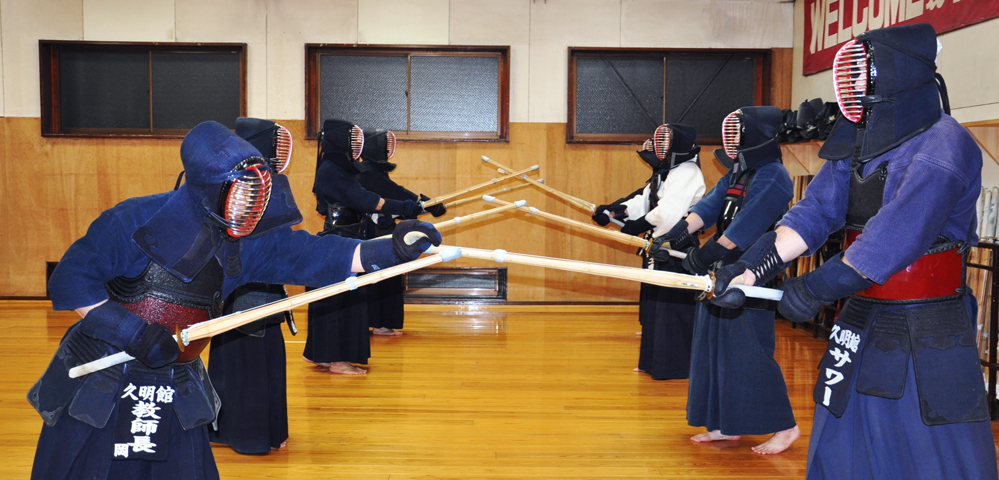
Kyumeikan Kendo Dojo

Greg Brundage with three Sensei after Kendo training Kyumeikan Dojo Tokyo
The next afternoon, I found a traditional Kendo dojo on the internet, called them up and made arrangements to train with them in the evening. Called the Kyumeikan Kendo Dojo, I was really happy to find most excellent Sensei teaching under the second-generation patriarch Akira Kubo, who holds a 7th Dan ranking - one Dan below 8th which is the highest. There I received classic Kendo training and a terrific workout. I’d brought my Kendo uniform and armor with me from Beijing (which I’d brought to China from Korea) and dearly wanted to have a good Kendo connection in Japan and consider myself fortunate indeed to have found this traditional, yet international dojo which has branch schools all over the world. After training, I had a short time to interview Master Kubo who said, among other things, that Kendo is the apex of the martial arts world. In a way I understand what he means. The mind can cut, separating this from that and unify bringing things back together. I would very much enjoy exploring this topic further with him the next time we meet.
In any case, it was a brilliant and meaningful conclusion to our Wushu journey in Japan and like always I must give thanks to so many people we met along the road in Tokyo, Kyoto, Nara, Himeji-jo, and most especially my dear professor Fujimoto in Takamatsu. We will - God willing - meet again!
For The Silk Road Kung Fu Friendship Tour Part 27, click here.