
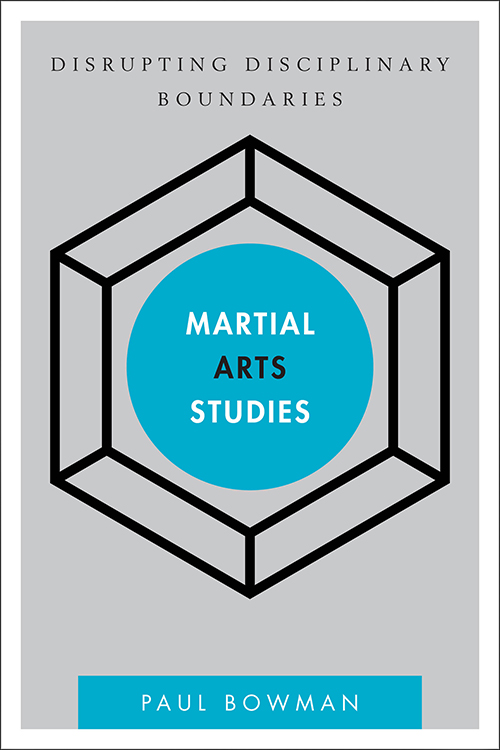
 Paul Bowman has just authored a new book, Martial Arts Studies: Disrupting Disciplinary Boundaries, published by Rowman & Littlefield. “Martial arts studies” is increasingly circulating as a term to describe a new field of interest. Many academic fields including history, philosophy, anthropology, and Area studies already engage with martial arts in their own particular way. Bowman’s new book ponders the question, “Is there really such a thing as a unique field of martial arts studies? This is the second part of an interview with Dr. Bowman on this subject.
For Part 1 of this interview, click here
GC: I love your notion in your book of Fight-Club-ization. Can you describe that succinctly for our readers?
PB: Fight-Club-ization is a rather ugly term that I use to describe what has happened more and more publicly in martial arts since the early 1990s – since the emergence of the UFC specifically. It refers to a change from accepting on trust that this or that martial art is “the best” and that your instructor is the greatest martial artist who ever lived, to demanding verification in the form of trial by actual combat. But it’s also more than that. Many “great” martial artists have traditionally said they wouldn’t compete because competitions have rules and hence are biased against certain approaches. But “no holds barred” fighting called the bluff of many people on that. Hence the explosion in MMA. But there’s also a bit more to the idea of “fight-club-ization,” for me. This relates to the fact that Fight Club was all about the rediscovery of masculinity and the rejection of “culture.” Yet even in the film this rejection produced a new (sub)culture. So what also interests me is the interplay between “tradition” and the rejection of so-called “classical” martial arts in favor of a kind of “scientific verification” – something which, inevitably, produces new cultural conventions and new traditions.
GC: What do you foresee as the ultimate outcome of Fight-Club-ization?
PB: In one way, it’s just a term for what I think happened in Western martial arts from the 1990s onwards. So it’s a way of thinking about a historical period and a cultural change – or, if you can stomach such a phrase, the deconstruction of martial arts. But I don’t think it’s the end of the story, or that it will necessarily smoothly transition into something that grows directly out of it. I don’t think history moves like that. I don’t think new things grow on top of old things. I think that established things are often blindsided by the unexpected, and bull-dozed out of the way. The historian of science, Thomas Kuhn, used to talk about “paradigm revolutions.” One minute everyone’s happily working away on their normal stuff when out of the blue something utterly unexpected comes along and obliges everyone to change what they are doing. Of course, things are not so simple. History is not simply linear either. There are many contexts and many ways of doing martial arts. Many places and practices have been utterly untouched by fight-club-ization. Many people are still turning up at Tai Chi classes firmly expecting to learn Jedi-like skills. (Worse, there will still be teachers who claim that that is effectively what they are going to teach them!)

GC: Do you feel the so-called reality-based arts have lost the moral compass of traditional arts?
PB: Actually, I don’t accept the idea that martial arts have one pre-ordained moral compass. Martial arts are supposedly about fighting. We picked up ideas about pacifism more from the 1970s TV series Kung Fu than from any actual dimensions of Kung Fu as existing in China, Hong Kong or Taiwan – even though we think we get the “pacifism” idea from Chinese arts. So I am against this kind of orientalism. However, I don’t dispute the idea that moralities emerge in communities. Norms, behaviors, codes, etc., inevitably arise once you have a community and a hierarchy. The Cosa Nostra and the Triads all have moralities. So do so-called reality-based martial arts. Their credo is “self-defense.” And this cannot be divorced from moral ideas about sovereignty, property, right, and so on. Moreover, in the end, if modern forms of “Western” martial arts come to mean that we no longer evoke sentiments that come down to us via orientalist ideas about Taoist pacifism and so on, then that’s probably a good thing. By all means, be a Taoist, be a pacifist, but I don’t want people to think that these discourses are part of the essential structure of, say, Tai Chi. In and of itself, a martial art is neither moral nor immoral. In fact, it would be quite easy to argue that Tai Chi is utterly immoral. For instance, just think about how treacherous it is: come to me, it says, I’m soft and gentle, I’m letting you in. Then, snap, crash, bang. You’re in pain, or damaged. Why is that more moral than raising your fists, a gesture which clearly says, “Back off or I will hurt you”? Isn’t that more moral than treacherous Tai Chi? I’m joking here, of course. But hopefully you get my point.
 GC: What do you think about the interplay of modern media and martial arts, particularly the recent rise of Chinese cinema in the global market?
PB: The short answer is: I love it. The long answer is: I think quite a lot about it. But what I’d choose to say about it here is that your question hits the nail on the head. For me, my starting point has always been that there is a profound interplay between modern media and martial arts. I think this relation is one of the most fascinating things, something that warrants lots of close attention.
GC: China is craving that global box office blockbuster. Right now, the dominant Chinese film genres are rom-coms, war films and martial arts movies. What do you think might be the impact on martial arts if they succeed with a martial arts film?
PB: I think the basic issue here is not about genre, but about the fact that much filmmaking is now conceived and executed with a transnational audience in mind. Every big film-making institution (studios, investors, certain directors, etc.) have their eyes on transnational or more or less global success. To do this, we are seeing much greater financial and production collaboration and cross-investment. Some film scholars have recently argued that rather than Chinese film changing to appeal to Western audiences, we are seeing a much greater change in Hollywood styles, as the influence of Chinese, Hong Kong and Korean (etc.) film styles are taken up in US film-making. I think that all of these things have an impact on the kind of martial arts people are interested in and know about. But I suspect that by far the biggest impact on martial arts practice, in terms of films having “influence,” nowadays comes from the information people can glean about the styles they see in films by researching online and in the DVD extras and “behind the scenes” or “making of” clips and documentaries.
GC: Another notion I found intriguing was the idea of “eclipsing the sun” as a means of study. Can you describe that succinctly for our readers?
PB: Yes, that was almost like a “thought experiment.” The idea came to me when I remembered an old TV news item I saw as a child, about the ways that a solar eclipse could help scientists to learn more about the sun than they could on a normal day. This was said to be because the sun is normally so blinding, which means that even though it lights everything up, you can’t actually see it itself. However, in the 1970s, an eclipse allowed scientists to see the sun in a new way: the flares, the rays, the activity on its surface and around it. So I used this idea as a way to think about the movement and migration of martial arts around the world. I said, okay, we know about the movement and migration of the famous teachers, but let’s block these out or bracket them off and forget about them, and instead look at what else was going on around them – to see what else, other than ideas about their own supposed inherent greatness, enabled them to become so influential, and so on. What I proposed was that the film and media discourses that were springing up like wildfire during the 1960s and 1970s in particular are arguably more important than the migrant martial artists themselves. At the very least, it was these wider discourses which prompted people to flock to the “famous” teachers, making them famous and making them influential.

GC: What happens if “eclipsing the sun” is applied to someone like Bruce Lee?
PB: Well if you eclipse Bruce Lee, then what you are left looking at is less the star image and more the complex field of film and specifically of action cinema. It was action cinema that “made” Bruce Lee – just as much as he gave so much to action cinema. The point is: without film and TV we wouldn't know anything about this man. He would just have been a man. He was catapulted to fame and influence via TV, first, and then film. However, people get very confused, and think that when we talk about Bruce Lee we are talking about someone we actually know. We’re not. We’re talking about a complex cultural construct: an image, an inspiration, a muse, and not an actual individual we happen to bump into in the street. I’m not saying he wasn’t a great martial artist or charismatic individual. I’m saying we should leave that discourse to his friends and family and the other people who knew him. All we have are written words and recorded images. This means we are dealing with a collection of texts.
GC: What else might you be working on in the future concerning martial arts?
PB: At the moment, as I mentioned, I am developing a martial arts studies research network (mastudiesrn.org), which is largely UK-focused, but absolutely open to international input; an academic journal (martialartsstudies.org), which I am developing with my colleague Dr Ben Judkins who is based in the US; and the annual martial arts studies conferences at Cardiff University, which attract delegates from all over the world. In addition, I have recently been asked to develop a martial arts book series, and this looks likely to happen in the near future. So these are all ways in which I am trying to facilitate the development of the area(s) of martial arts studies – by establishing some necessary institutions (conferences, journals, books). Unsurprisingly, I also find myself supervising more and more PhD students working on various aspects of martial arts and culture. And, of course, I continue to read and write about many aspects of it. The book I am currently writing is one that I hope will straddle academic and non-academic readerships. It is directly inspired by a famous book of cultural criticism published in 1957 by Roland Barthes. Barthes’ book was called Mythologies, and it is a classic of cultural analysis. It is made up of short essays, each on one aspect of modern (mid-century) life in France. It’s very much like a proto-blog. My book is called Mythologies of Martial Arts and I hope it will carry the spirit of Barthes’ classic into the area of martial arts studies, and also make some of the theoretical questions that organize martial arts studies a bit more accessible to a non-academic readership.
GC: Can you suggest a few books that are leading the way to martial arts as an academic field?
PB: There are many, and it depends on your specific interests. Before buying books, I’d personally recommend finding out what’s being said about them on certain martial arts studies blogs. The best of these blogs is Kung Fu Tea: Martial Arts History, Wing Chun and Chinese Martial Studies (chinesemartialstudies.com). This blog is “the best” because each week it provides highly readable but very scholarly essays on all aspects of martial arts (especially Chinese arts), as well as reviews of books, interviews with key practitioners, scholars, authors, and academics, and (an aspect that I particularly appreciate) regular roundups of Chinese martial arts in the news. This latter feature always includes a section on academic and semi-academic publications. So I would always direct readers there. (The author of that blog is also, not coincidentally, my co-editor on the journal, Martial Arts Studies.)
About author:
Subscribe to KungFuMagazine.com here.
Get your print edition of the MID-AUTUMN 2026 here.
Gene Ching is the Publisher of KungFuMagazine.com and the author of Shaolin Trips.


