
Photos Courtesy of Brian Chumney
Lau Kar-Leung Photos Courtesy of Mark Hougthon

Source: Mark Houghton
Since the rise of Mixed Martial Arts (MMA) across the globe, and the Ultimate Fighting Championship (UFC) in particular during the last decade, there is a prevailing view that most traditional martial arts have become essentially useless for real practical use, being gradually superseded by the hybrid fighting methods developed specifically to be used in the context of protected and controlled sport combat. However, in spite of MMA’s profile and credibly continuous growth, the veteran stuntman, action director, producer, and traditional martial artist Master Mark Houghton isn’t worried a single bit over the validity of his first martial arts love: Lau Family Hung Gar Kung Fu.
Kung Fu Development
Master Mark Houghton, also known as Ho Mak (何麥), believes that every martial art was developed within a certain context, and has evolved through time within certain parameters and new contexts. In this regard, the longtime direct disciple of the legendary filmmaker and martial arts Grandmaster Lau Kar-Leung (刘家良) comments, “Since the beginning of times, conflict and clashes have existed within humans; therefore, strategies for these had to be developed in one way or another. Hand-to-hand combat, as well as with basic tools and weapons, eventually had to be worked and polished, to the point of developing self-defense systems. Most styles of Kung Fu were created under these circumstances. To defend oneself and others. To maim and kill when necessary.”
Master Houghton further elaborates, “Although Hung Gar basis is in fighting, the system continued to be expanded generation by generation. Basic concepts of anatomy, medicine, training, and more, were included, tested, rebalanced, always depending on the context of each generation and the persons behind the changes. It was our ancestors and their strong desire to survive and transcend. Hence, Hung Gar today is much more than just a means to plain physical conflict; it teaches so much, including spiritual, ethical and moral self-improvement values, which have contributed greatly to society. Martial virtue or mo duc (武德) is a big part of Hung Gar and Chinese Kung Fu in general, which cultivates respect, humility, trust, honor, where the principle of non-injuring the opponent represents the peak of martial arts skills.”

Source: Mark Houghton.
A Unique and Proven System
From the end of the 1800s to present day, Hung Gar’s efficiency in real-life confrontations has been proven time and time again. It is well established that important ancestors of the style, such as Wong Fei-Hung (黄飞鸿, 1847–1925) and his student Lam Sai-Wing (林世荣, 1861–1942), were involved as military trainers in Guangdong and Fukien. During the times of the Second Sino-Japanese War, a few of the next generation of descendants, such as Lau Jaam (刘湛, 1897–1963), Chan Hon-Chung (陈汉宗, 1909–1991) and few others, were involved in training different armies and civilian groups as well. Years later, Lau Jaam, whose third child was Lau Kar-Leung, taught the Hong Kong police effective techniques. The shield and baton methods used by the riot police units were said to be derived from the rattan shield and broadsword (藤牌單刀) of Hung Gar.
According to Master Houghton, his sifu’s father, Lau Jaam, once was involved in a famous confrontation widely reported in Hong Kong newspapers, where he and two others took on several dozen Chiu Chow (潮州) coolies at a fish market in Sheung Wan, Hong Kong Island. Being outnumbered and surrounded by so many attackers, Lau Jaam decided to smash a long bamboo pole against a wall so that it would splinter, and then used it to slash and cut most of his aggressors – a real-life event which inspired the famous teahouse fight scene in the blockbuster Drunken Master 2 (醉拳II), directed by Lau Kar-Leung. Master Houghton notes, “Hung Gar is a fighting art, and some of these older masters or their students were involved in fights more often than people would like to admit – though they eventually became wiser and distanced themselves from those deeds.”

Source: Mark Houghton.
Enter the Octagon
At the same time of working in the film industry, Master Houghton also worked on and off as a bodyguard and knows very well the difference between real-life confrontations, sports, and movie fighting. In that respect, he explains, “Again, most styles of Kung Fu were not created as sporting activities. MMA on the other hand is exactly that. I have endured numerous life-threatening attacks, received over 400 stitches from knives and parang, the Southeast Asian equivalent of the machete. I have seen a stream of blood shooting out my femoral artery. These situations have very little to do with sport combat, and fighting the way you fight in MMA would not be always sensible. MMA has evolved as a technical and regulatory form of sport combat. It is a protected and safe fight between two persons on a matt, with gloves, with no shoes, no weapons, no multiple opponents, etc.
“Having said that, in order to do well in MMA, one must acknowledge the importance of understanding their rules and their level of physical preparation. My daughter Charlene initially showed interest to enter in sport combat competitions, yet she suddenly felt that there was a great part of the techniques she learned in Hung Gar that were not effective enough, where in reality they were mostly forbidden. From eye-gouging to head-butting, from breaking joints to clawing the throat, techniques that would effectively disable an attacker on the street cannot be used in the cage. Society has changed, now as Kung Fu teachers we must know what exactly to teach to each individual. If you have students that want to test their skills on the streets, they will soon end up in trouble with the police or in hospital. So they might want to enter in sport combat competitions instead, but must understand the greater implications and differences.”

 Like Father, Like Daughter
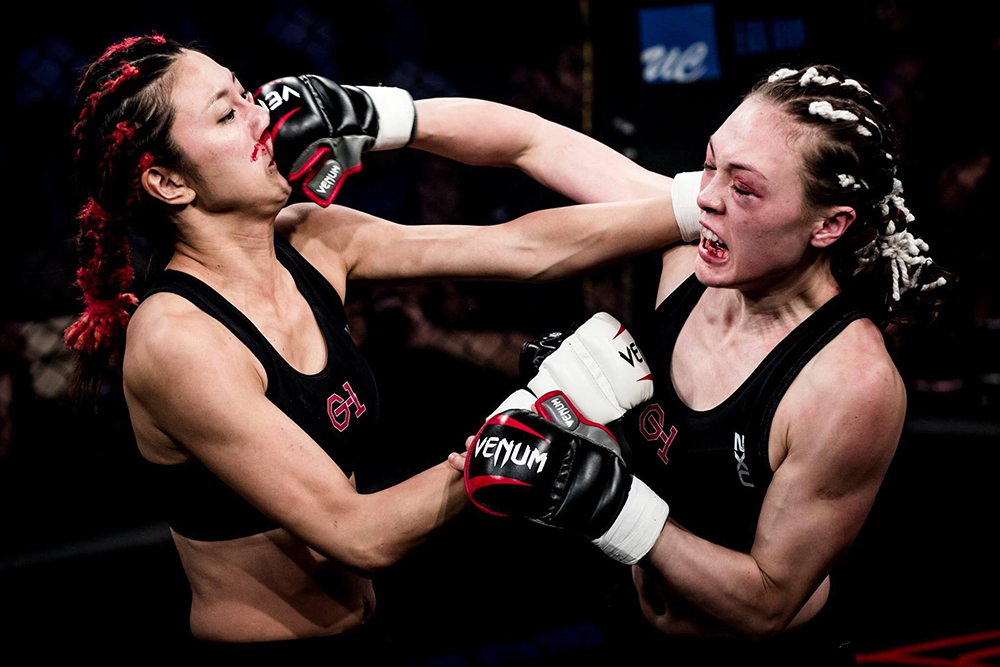
Charlene Houghton (何慈茵), at the age of 27, is an extremely accomplished martial artist. She started learning from her father at age 3 or 4. She stopped training when she was around 6, after kicking a boy in the face when she was in kindergarten. Then she took training again from around 14 to 18, specializing in Lau Family Hung Gar. Later, she earned her degree from the Department of Physical Education of the Hong Kong Baptist University and soon after that became a personal trainer, food nutritionist, martial arts teacher, and also started a successful career in TV and movies. Lastly, and as if all that wasn’t enough, Charlene also embarked on a more important mission: to show people that Kung Fu is not only for performance but can be used in fighting.
With sheer commitment and under the pressure of upholding her family’s honor and Kung Fu lineage, Charlene has been participating successfully in various combat competitions since 2016. For instance, she fought on opening night at the E-1 World Championship in Hong Kong, surprisingly losing by decision after landing heavy blows and several times sending her taller opponent to the mat. Then, she took part in an innovative MMA reality show produced by Hong Kong TV Entertainment (ViuTV) called G-1 Fight Club Champion, and its sequel G-1 Fight Club 2, winning the championship’s gold belt after several elimination fights. More recently, she won a leitai (raised platform 擂台) fight at the National Arts Dragon, Lion & Unicorn Show and Martial Arts Leitai Tournament, held in Hong Kong in December of 2018.
Source: Charlene Houghton.
Making It Work in the Cage
When asked about his daughter’s success, Master Houghton reminds us that to make Hung Gar work in MMA requires building up a different set of skills and following a different approach to fighting, a different mindset. “First, you should start by analyzing what are the common techniques being utilized by MMA fighters according to their regulations. What are their basic skills, footwork, and combinations? How to respond to these attacks? Then, as you gradually improve upon these core techniques, you also have to start working significantly on your stamina, your endurance. Body conditioning and hardening methods are natural for us, but in MMA you must be ready to go for several rounds with full speed and power; this requires specific physical preparation.
“Lastly, you have to do tons of sparring; you must spar with anyone you can, different sizes, genders, and weights. Once a good level of preparation and understanding has been achieved, then you can start adapting elements of Hung Gar into your fighting. There are many refined body techniques in Hung Gar that would work very well in a close-range situation in MMA. Entering, hitting with the shoulders, with the hips, applying pressure to break your opponent’s balance, trapping and sweeping at the same time, etc. Hung Gar techniques can be applied with any part of the body, in any plane, in any angle. That is when it will start to make a difference. But it will definitely take a learning curve to adapt and use those techniques efficiently.”

A Profound Life Philosophy
From Master Houghton’s remarks and observations we can see that sport combat is unique and the average traditional practitioner will require special preparation to focus on it. Now, does that fact invalidate the effectiveness of traditional martial arts? Clearly the answer is no. While MMA does work as a great proving ground for hand-to-hand combat techniques, it still confines the fighters in many different ways. Master Houghton also emphasizes the benefits of learning traditional martial arts, which, in addition to stressing the "fighting" aspects, also incorporates other important qualities such as self-cultivation and the practice of martial virtue. He hopes that everyone will remember his Sifu Lau Kar-Leung’s cinematic portrayal of the values of mo duc, where, while his characters start learning the arts as part of the revenge narrative, ultimately, after extensive training and a journey of self-discovery, they end up sparing their enemies’ lives at the last minute, thus restoring balance to their own lives. Now that is Kung Fu!


