
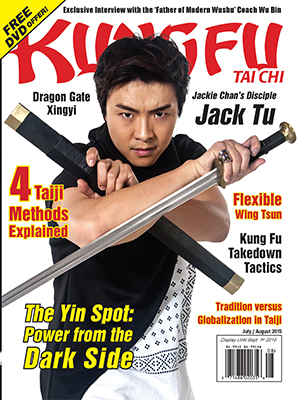
 Jack Tu is Jackie Chan’s one and only disciple. It’s a unique honor that he earned in 2008 after beating out 128 other candidates in a popular Chinese reality contest show called Jackie Chan’s Disciple. Jack is featured on the cover of our JUL+AUG issue. He is also a longstanding friend of Kung Fu Tai Chi so interviewing him was less formal than most. It was a good long catch-up chat with an old friend.
With Hollywood trending towards China and China’s own film industry growing at an alarming rate, Jack and I spoke extensively about what’s happening in the global film industry on both sides of the Pacific. For the past half decade, I have been covering Chinese and martial arts film for Kung Fu Tai Chi in a regular column titled Chollywood Rising, and I moderate our Martial Media and Popular Culture forum, plus I used to write about film back in my freelance days. Jack Tu has been active in the Chinese film industry since his discipleship, but he travels back to America to visit friends and family, so he’s seen the industry from the insides on both shores. This exclusive interview is some of the additional discussion we had that I didn’t have room for within the cover story. The interview took place at the Tiger Claw headquarters in the spring of 2015.
GC: You are THE disciple of Jackie Chan. Is that heavy on you?
JT: No, it’s more lighter because now I can control everything I do. When we have the ability to control, I don’t think anything is a pressure. When everything is given by God, by luck, then that’s pressure. I don’t want anything to be unseen. I want everything to be where I can see and touch.
We say Jackie is Shifu. He’s saying he doesn’t help us, but it’s not true, because everybody knows me as his disciple. So there’s 80% of respect right there. But does he help me a lot? Well, not really, but he helped me look at the world differently. He’s always telling us that everything you get, it’s not from other people giving it to you. It’s from what you do to earn all these things back. So for me, I don’t want to wait. I want to create my own films where I can just do it and then continue with it.
I was thinking I have to build up myself first. If I don’t build up myself, there’s no reputation and there’s no respect from other people. Then I think there’s no meaning for me to stay in this industry.
GC: So what are you working on now?
JT: I did a script for a film, and also producing a film. For the past year, after the Tea Master movie, I started thinking that instead of waiting for people to offer me a film, why don’t I create one myself? So I start gathering a few of the Lucky Sevens. At the beginning, I gathered four of us and was like, ‘Let’s do a movie.’ I wasn’t sure how we were going to get the funds, get the money. Then we started making songs and doing shows, but those still don’t add up for what we are expecting to make the film. And then we start thinking, ‘Why don’t we create a kids’ film?’ In China now, there’s no kids’ action movies. And then we created a song called ‘Dance of Love.’ And we start spreading them in whole China. Our goal in the beginning was to create like 50 to 100 kids dancing with this song with us together. And by doing this, we get paid by a lot of companies and a lot of people. So we did that for one year.
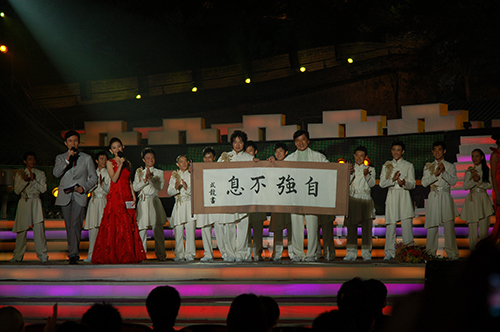
In one year, we raised our funds up to 6 million RMB in China. So we start with this fund and we start creating our own movie. We were like, ‘Who’s going to do the script?’ [laughs] Then I start thinking about it. Maybe I’ll try and do a script. I finished the whole script and give it to this professional scriptwriting team. And they all got interested. And they came to help me, and fixed some of my script and everything for free. And they also said they want to join this movie. I was like ‘okay’ so like from the end of last year to now, we gather my whole film group. It’s mostly from friends in the past and people who I work with in dramas or movies. Get along with them really well so I start gather all those resource and combine them into one. And now we got more investors. We even have the investor who invested in Teenage Mutant Ninja Turtles. And also people from the government in China, they invested in us too. So we went from 6 million, now it’s going up to 15–20 million RMB in just half a year.
And now we have everything set. We are also selecting kids, little kids. We’re trying to see what they can do. Most of the kids in China, they just dance and sing. They don’t do martial arts. They think martial arts is very tiring. Or the parents think, ‘I don’t want them to go to martial arts. It’s not good for their body. Make them go out of shape. Make them really short.’ I don’t want to find someone from the martial arts school. I want to find someone who has the look, who can dance, but I want to try to transform their dancing skill to martial arts. Because I think if they can dance, their body language will fit anything, like martial arts. I did an experiment for three months – one little girl was really good at dancing. I used one month to fix her martial arts and it’s really successful. So now we get ten kids, only ten kids, now I’m bringing them to my school in Los Angeles to fully train them. I want to see if they can adapt to martial arts. Because if they have the flexibility, they have the jumping, they have all those abilities, then martial art is very easy for them to adapt.
There will be ten main roles for kids in this film. There will be me, and my partner is Shi Xiaolong. Now he’s working with me too. He was joking with me saying, ‘Hey, two of us combined (because my name in Chinese is Tu Shencheng – my last one is Cheng, his last one is Long), we can be like Cheng Long!’ I never thought of that. When we do advertisement, we can put ‘Cheng Long’ partners. I think it was very coincidental.

And when we were working together we start thinking of like it’s just me and him and the kids. We still need lots of stars or big-name actors to come and join us and help us. So we start spreading this news and start finding friends like Liu Yifei will help us do the promotion. Also Chen Guokun and the Chopstick Brothers. In China, there’s this song called the ‘Little Apple (xiao ping guo)’ the singers of that song – because I helped him with a film called Lao Nan Hai. All the action choreography and all the stunt double is done by me. I help them create everything in that film. That was the first time working with Daniel Lee, the director of Dragon Blade. Daniel Lee is also going to help me with the film, being a producer.
GC: So your production is independent, outside of Jackie Chan’s production company?
JT: Because after six years, there is this saying, ‘Master take you into this door, but going out of this door is all by yourself.’ Our mind is that we don’t want to use our Shifu Jackie Chan to help us with anything because if we have the skill to survive in China under him, then we have the skill to come out ourselves. It’s been 5 or 6 years. I have to have a break point. I’ve learned lots of stuff. I’ve had lots of resource. I’ve lots of friends. So I was thinking why don’t I gather them all up and help me do one project. And we’ll make this project fun.
The market in China now is with the kids. So I don’t want to make some fearsome action film like Donnie Yen. Those – when we watch too much, we get numb. Now the kids in China market is really big. We do a kids’ movie, everybody can watch. The whole family can watch. If we do a really brutal action film then it’s only the adults or the teens. They cannot bring the kids to watch this. So we’re thinking of the market and everything.
The story is pretty fun. The story is about the modern time and the past time. The past time is about the tribe, a village in China, it’s very old. And everybody in there don’t even know cell phone and computer. They still use the horse, the sheep. Everything in there is like the old age. But hey, adapt to it and it’s in the desert. And one day, there came this whole new people with big vans and trucks, loaded with technology, and they’re all from America, from U.K., from Russia, from Korea. People from different worlds coming to this village, and then the villagers is very happy to see: ‘Hey, there’s foreigners and we have to welcome them.’ But when they are coming here, they have spotted this site – this ancient site that once said they had this treasure in there. And because this village is weird because in that place is like six different types of races. Races means like Zhu, Hanzhu, Miaozhu, Zhangzhu , Mongzhu – Mongolian, Tibetan, there’s Chinese people. They all get along with each other and live there a very long time. So people from outside start thinking, why can they get along like this and doesn’t they have cultural difference? But they are all there to protect items, but it’s not items. It’s their belief. For outsiders, they think it’s treasure. And so then there’s a funny thing – because I want to make a comedy – between technology and the ancient thing. And how ancient thing will only work in desert, not the newer technology. Because in there, there’s no electricity, there’s no signal. There’s nothing. Try to make this more different from what China has done before. We call it the Eye of the Desert. Before it was called Super Action. But in China, they think the Action thing means something spy-ish work so they don’t want us to use that name.

GC: Are you trying to make the global hit film like China really desires right now with this?
JT: Global films are more super action. The kids’ movie is more towards the global. In that film, I also invited Jean-Claude Van Damme. He might come in and help us for one or two days. We were asking Mike Tyson, but his price is too high now. I was thinking I want to have a fight scene with Mike Tyson. For one week, he asked 4 million.
GC: When does Eye of the Desert start filming?
JT: End of June.
Another funny thing is that while I was working on this film project, another film came to me and that other film is called Vital Gate – mingmen) – the pressure point in the back. I was going to make a film called Qimen Dunjia with Daniel Lee, the director of Dragon Blade. We had this whole concept of this movie and he was very interested. And he came to me and said, “I want to do something different.” So I postponed the Qimen Dunjia and went to the Vital Gate because the topic make me more want to do it because it’s about the corruption of the government. If he said it was just a normal action film, I would just do this movie, but when he said ‘anti-government corruption,’ this type of film in China, no one has ever done it. And I was asking, ‘How can you do this anti-government corruption film in China? Don’t they restrict it?’ He said, ‘No, now they open it.’ And he’s the one who’s working for the government. He works in CCTV. So he knows all the rules on scripts.
I want to try this because, in the past, Jackie follows this Policeman story, and he has this role for policeman. But in Vital Gate, it’s the role of a U.N. officer, military, keeping peace in Africa. China now sends a lot of U.N. peacekeepers into Africa. He’s using that story based in Africa, coming back to China. The story is about when I was in Africa, I served my tour of duty, but my whole team got blown up. And I was the only one who survived so I got sent back. I was sent back and there’s no more job and I cannot go back to my duty again, so I start working as bank guard. And when working on the bank, I try to find my commanding officer, because I want to find a higher job. I want to serve the country, not serve the bank. With the corruption, we see these people get rich overnight, and they’re not the ones who deserve us to serve them. We want to serve the country. We want to do something big. The officer was saying, ‘Hey no, you just came back. You have to rest for at least one to two years in order to go back to the field.’
The story begins with my sister. She’s a party girl. She always likes to party and meets different kinds of people. She went into this mess, this kind of situation, where she holds the money in and out of a boss. It was given to her by a TV host, telling her to run away with it. Then my sister got caught. And she hid it somewhere else. And they threaten me to give them the titles or they will do something to my sister. This opens a bigger door.
They train fighters to create their own competition, like Wulinfeng, like all those fighting competitions in China. And they fix the fight. They say, ‘Hey, this guy is from Thailand, the King of Thai boxers, and this is the King of Karate,’ but they know nothing. They’re all just Chinese people trying to be Japanese or trying to be Thai. And they go in there and are just beat up by Chinese people. So they start challenging and lock me underground, in a parking lot, and I have to find a way to get out.
Because I’m a UN peacekeeper, I have to know all of the water tunnels, all the electricity tunnels and everything underground. The scriptwriter is the one who created a subway station in Shanghai. He knows tunnels and how to escape through tunnels very well. So this film has a lot of indoor and tunnel fight scenes, underground things. It’s going to start filming in Anhui and Shandong. And my dad is going to have a role in it too. There are lots of U.S. fighters. I’ve got lots of MMA fighters and UFC fighters, Zhang Jian, a new China MMA fighter, and Liu Hailong coming to help me too.
But I still want to keep it to traditional Chinese martial arts because in Vital Gate, everything is traditional martial arts. I don’t want to make it too UFC or too MMA like Donnie Yen. They have what they have but I use traditional martial arts, the pressure point fighting skill.
Anhui Ding and CCTV are investors, China film and Anhui Network.

GC: I’m going to ask you that global market question again, but now for Vital Gate.
JT: For Vital Gate, I’m only thinking to do film festivals. For Eye of the Desert, because it’s more comedy, I think the international language is comedy. People laugh and have fun with the film. I’m not looking at this whole thing like The Raid, like Ong Bak, killing from the beginning to the end.
Ong Bak, Tony Jaa, has this kind of film. His films, people die, kind of brutal. I challenged myself saying, ‘I want to do something that, in the film, no one dies.’ To kill a person is very easy in film. For him to not die and still obey me, it’s really hard. They make it very tense. But I am always going towards something that’s very leisure[ly] and fun.
So that’s why I have two films coming out – the first one I’ll target the China film festivals because I want to get my place up in China films, the new action actor coming up. And the Eye of the Desert is for everyone in the world. Because both of these are going to have a second and third one. Vital Gate already has a second script coming up. The second is more towards Hollywood. It’s about the Chinese troupe going to Mexico, trying to catch the guy who took all the money in China and leave. But when we go over there, we have to obey the law – do something different to get him out. The second is targeted towards global, but the first one, we play to the China market. Because there’s no good action films in China now.
Stay tuned for Part 2 - coming soon!
About author:
Subscribe to KungFuMagazine.com here.
Get your print edition of the MID-AUTUMN 2026 here.
Gene Ching is the Publisher of KungFuMagazine.com and the author of Shaolin Trips.


