
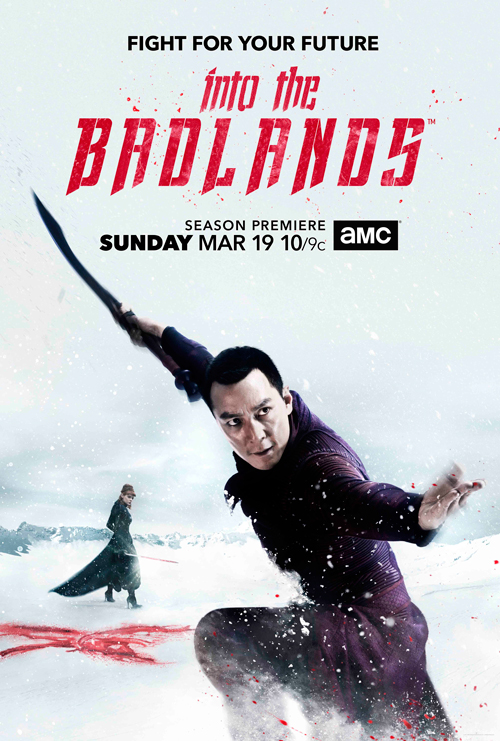
 There's something really unique about AMC's INTO THE BADLANDS. The cast is diverse, not just the supporting characters, but the lead roles. The leading man, Daniel Wu (Sunny), is Asian. In an era where whitewashing has become a hot-button topic in Hollywood, an Asian male lead is quite refreshing. INTO THE BADLANDS is egalitarian about race and sex. The leading ladies are all as kickass as the leading men. Some women, like the Widow (Emily Beecham), are even more lethal than the men.
Diversity in TV is not new. STAR TREK boldly went where no man (or woman or pointy-eared alien) has gone before, way back in 1966. The Enterprise crew was ethnically diverse with Sulu and Uhura, and even more so culturally (remember that America was deeply entrenched in the Cold War back then – Russia was the enemy – so Chekov's character was bold indeed). And there were women serving major roles on the crew, albeit in skimpy Star Trek skirts; but still, it was only the sixties. Nevertheless the lead roles of Kirk, Spock and McCoy were still cast in Hollywood as white men. And while there were some fierce female fighters in the show, most all of them succumbed to Kirk's manly charms by the end of the episode.
Since then, there have been several TV shows driven by strong women warriors like WONDER WOMAN (1975–1979) and XENA: WARRIOR PRINCESS (1995–2001). However, there hasn't been an American TV series with an Asian male lead that wasn't a comedy. Daniel Wu is carving a new path for Asian leads by sword. Actually, it's two swords.
“Every force has its equal. Fear, peace, dark, light… one can’t exist without the other.” –Sunny
“We wrote it in the script," says INTO THE BADLANDS creator Alfred Gough about Sunny being Asian. “And we just felt like, in the beginning, because it was very loosely based on the Monkey King, Miles [Millar, INTO THE BADLANDS' other creator] and I always saw the character as Asian. We didn't want him to be white. It's something that we really tried to do in the show, because we're in the future, we try to have a lot of people of color in the show. It was easy in Ireland, to be perfectly honest. But they've also been good. We'll bring people in from America sometimes and people from the U.K. But we were like, it's the future and the future isn't white.

“So for us, Daniel is Asian American. Aramis [Knight, who plays M.K] is actually the perfect child of the future – he's East Indian, Pakistani, German, like he's somehow in a blender. And then Veil [Madeleine Mantock] is actually mixed race as well. I think her mom is white and her dad's black. And there's Cung Le who is one of the Abbots. So that is something to us that is actually very important – that it's representative of what we think the future is. But we always wrote him as Asian and it just felt like that's what it had to be. And it's always trying to find more opportunities for more Asian actors to come into the show. For what we see our world as, flew in on the world of Donald Trump, but that's what it is. It's very multicultural and mixed race. But it's funny. And by the way, nobody ever said, 'Oh yeah, that guy should be white.' Everybody was like, 'Alright, great! He's Asian. Let's go!' We always wrote him as Asian and everyone said, 'Great! He's Asian. And now we got to find that guy.' And then we went on the hunt to find the guy. And luckily we had the guy sitting next to us, so that was even better. So we had an ace in the hole.”
Daniel Wu was originally hired as Executive Producer for INTO THE BADLANDS. He was to oversee the fight choreography, but got tapped to play the lead as well. “It's such a great ace in the hole," continues Alfred. “People are like, 'Wow, he's really good.' He's a f**king movie star. You just never met him before. It's like people in China suddenly put Brad Pitt in a television show and like, 'That guy's good.' No s**t. So I know. It's great.”
Having a Chinese lead brings some special perks. It doesn't hurt when AMC, along with every other network and studio on the planet, is trying to penetrate the Chinese market. China has the world's largest population, and that's continuing to grow, soon to become the largest consumer of film and programming of any nation. “It's on a streaming service in China,” confirms Alfred. “In Hong Kong it was on. It's doing well in Asia. We got an Asian movie star.”

But Hollywood has shied away from Asian leads, so much so that whitewashing has become the Asian response in the wake of the #oscarssowhite protest of the 2016 Oscars. Being a star on both sides of the Pacific, Daniel Wu has a unique perspective on this issue. “It's interesting because Doctor Strange is playing in China now,” said Daniel when interviewed last November. “No one cares. No one cares because I don't think it's as big an issue to Asians in Asia as opposed to Asian Americans who have been struggling for representation in Hollywood for a long time. Asians have always had their own market, right? So it's interesting to see that dichotomy. I'm kind of caught between the two, because at the same point, I really like Tilda Swinton. She's a great actress. It might be cooler with her in there. But at the same time, I understand. It's a role that was meant to be Asian and they switched it to someone else and taken an opportunity away from a group of people. And there's a bunch of actors that I'm friends with that have been struggling for years and years and years in Hollywood to get even a part. And now these Asian parts are being farmed out to other people. But I think we're in a much better place than we were fifteen years ago. There's Asians everywhere in TV. There's a lot of diversity in TV. I think movies is coming slower around, but I think it's coming. The unfortunate thing is that it's the economic conditions that are making that happen. The China market is making them put more Chinese actors into movies so it's not necessarily a good-hearted diversity decision. It's more about an economic decision opening up to another market. But hey, I'll take that. It gives us an opportunity.”
Today's market is global. No matter what your product is, you want to reach the whole wide world. Daniel Wu shared a recent experience about that spread. “I was in Africa in May and I was in the Johannesburg airport. I was getting a SIM card for my phone. I did the transaction. It was all done and the guy's like, 'Can I ask you a question?' I'm like, 'What?' 'Are you the guy with the two swords?' It was interesting to see how quickly the show moved all over the world. Martial arts fans, they found it. And they love it. And that's great.
“But what was surprising was that we got a lot of fans that are fans of the diversity of the show, especially my relationship with Veil. I didn't really think about it while we were making it, but an Asian guy with a black girl, that's never really been seen on TV before. There's this whole twitter following called '#colormebadlands' – people of color that are fans of the show. Now I'm getting tweets from some women; they're like, 'I want to have your blasian baby.' That's a whole demographic that I've never really been introduced to before. It's really cool – African American females who are really into the show.
 “What I realized is that through the other characters, like the Widow and all that, there's a whole demographic of fans that we get that we didn't expect – this female audience. Obviously they wrote that for the female audience but I really wasn't sure it worked. But it did. There's a lot of fans of just the Widow and what she does because she's representative of this feminist ideal. Obviously the main fans are of the martial arts stuff. There is that. There's all these auxiliary fans that are into the show for different reasons other than the martial arts and that was a surprise.
“I felt we brought in an audience through the story, not because of the martial arts, and they got behind the characters. And that's what you want. You don't want it to be just crazy action and a crappy storyline. It's like porn. Cut through the story to get to the action, right? You want it to be a good cohesive whole, a good TV show.”
“The appearance of weakness is the greatest advantage.” –The Widow
Even though Ally Ioannides is the youngest woman warrior in the cast, her character Tilda is one of the most lethal. Such a powerful role is not lost on the young actress. “Not often do you come across a script like this at all, especially for a girl who is my age,” says Ally at nineteen. “Very rarely would I be able to play an assassin who’s actually bred, who’s not somebody who’s just there, and their assassin is just hot and sexy. Tilda is badass. You really see that in this season. I really commend our writers for our female characters and I’m so honored to play Tilda, so honored to support this. She’s really powerful, really bad ass and scrappy, but also has a really good moral compass, and that’s important. I think she’s a good role model.
“The Widow's whole thing is like, 'F**k patriarchy.' That was my first kind of intro to the whole show. When I first heard about it, my character was described as like a minion of someone who's trying to topple patriarchy, and I'm like, 'I'm in. This is exactly what I want to do.' I definitely think that especially this season we're playing so much more on that. Tilda has grown so much and there is a lot more that we discovered with fighting back.”
While the Widow, Tilda and their bevy of lethal Butterflies carry most of the weight of female fighters, Lydia finally gets a fight scene in Season Two. “The thing about this,” says Orla Brady, who plays Lydia, “I was promised fighting this year. And it's not as elaborate as I would love because it's not beautiful, martial arts balletic stuff like Daniel gets to do or like Emily gets to do. However, it's very raw. But it's like Lydia is discovering that she can kill. It's almost like she didn't know. And in a moment where's she's put in danger. Have you ever been in that situation?”

An Ireland native, Orla started in theater and is a veteran actress who has appeared in over forty television programs since the early '90s. In between filming INTO THE BADLANDS seasons, she worked with Jackie. “I did this Jackie Chan film during the year. I did this film called THE FOREIGNER, but I didn't get to work with Jackie, which I was really sad about. I only had one scene with him and it involved us being so far apart that we only ended up meeting and chatting rather than doing. But it's a lovely film. Pierce Brosnan and I play the baddies and Jackie is the good warrior who is kind of against us. I seem to have got glorious actors to work with the last couple of years. Lance [Henriksen, who plays Penrith] and Pierce and Jackie. And Daniel Wu in fighting. And I could go on.”
But back INTO THE BADLANDS, the power of Lydia's role isn't lost on Orla any more than Tilda's power is lost on Ally. “What I love about this is that you don't often get scripts where – the writing between the men and women here – there's little differentiation in terms of how the protagonist is. They just seem to write characters and they don't make the female characters subordinate to the male characters. So many scripts you get – even very good scripts – I mean look at – there have been things out like TRUE DETECTIVE – it's a good story. It's beautifully shot. But the only women I've seen are prostitutes, dead bodies or...well, there's one vengeful wife. And it really, really makes me unhappy to see that. These writers just write characters and they created a show at the beginning with five females and four males and all of them have a story. So I really love Lydia because there are so many scripts I've read in the last couple of years that [laughs] just honestly. [sighs] You know the kind of thing. You have to be careful out there. Or the kind of lines you get to say. To be sort of an autonomous character is lovely.

“I don't go out much. And I'm not a very great social media person yet, so I don't get tons of comments about this. The gist I got from being at ComicCon was just that people locked onto different stories. What amazed me was that some of the younger women were very interested in Lydia's story, and I found that a little bit curious because I assumed we follow our peers in stories. We want to tell our stories and have other people tell our stories, but it's almost like this character is so put down at the beginning or during the course of season one. She's so kind of put upon. And it's the thing that interested me in the character in the first instance, is that if a woman is entirely thrown away by her husband, if she is rejected and kind of let go by society that favors, I don't know, youth, attractiveness, what does she do? What does a woman like that do who's kind of lost everything. Does she sort of just lie down and take up knitting or whatever? Or does she come back fighting? Lydia is a fighter. She's just not going anywhere. I love that about she's just determined not to be an invisible woman. And I think that's a good story to explore dramatically, especially in post-election times where, given the viewpoint of a certain candidate, well, many are struggling to recover from that. We can't go back to that idea of women. We can't. And so Lydia is my little hope that we might tell a story of a resurgent woman. Maybe that's reading too much into it but I love her for that.”
When it comes to INTO THE BADLANDS women warriors, everyone bows down to the Widow. Emily Beecham has developed a complex character, a hell-bent fury who wields swords, shuriken, and stiletto heels with sanguineous lethality. The Widow is arguably the next top sword fighter after Sunny. “I enjoy fighting Danny,” says Emily coyly. “It's a lot easier this season because we understand how it works. Actually, in our final scene fighting with Daniel in Season One, the ground is so slippery we were sliding a lot and hitting each other a lot of times with the swords going full speed. And you can't read that so much so Danny got hurt.”

The Widow has delivered some of the best fight scenes in INTO THE BADLANDS, but even though Emily enjoys the fight scenes, it's the Widow's journey that captivates her. “I was reading Art of War about strategy. My character is always about strategy.” Season One ended with the Widow on the run, recouping from a bloody battle with the Baron Quinn, struggling to be acknowledged as a Baroness. “She's gaining a lot of traction and power,” reveals Emily. “She's going to get taken a lot more seriously. She's trying to build the bridge and have more communication with people like the cogs and the clippers. She's trying to create a new environment – slowly – ease people into learning this new system and helping the cogs realize that they want it.
“Yeah, and she lost it. And that’s why she’s chasing M.K. She has a dark chi and wants to have her bit translated. We’re going to discover more about that…. I would like to see more facets of her character. As everything develops for her, I would like to see more of her true self. I would like her to discover her dark chi. We’ll see if she achieves that because that would be really fun. [laughs] We haven’t had a dark chi fight.”
About author:
Subscribe to KungFuMagazine.com here.
Get your print edition of the MID-AUTUMN 2026 here.
Gene Ching is the Publisher of KungFuMagazine.com and the author of Shaolin Trips.


