
 It was not my first kung fu fighting competition, nor my first trip to the hospital, but it was the first time I’d faced the painful decision of which to put first: fear of permanent injury, or the will to win. Later, the choice would seem obvious. But in the moment, as one of my teammates held a compact mirror up so I could see my damaged face, I wasn’t so sure.
This was the 2008 Wong Fei Hung Northeastern All Kung Fu Competition, back when I was a student of Sifu Joseph Demundo (Disciple of Yee Chi Wai) of Yee’s Hung Ga, Chinatown Branch, NYC. I was 31 years old, a writing instructor at NYU, and I had only about two years’ experience in martial arts. To be clear: This was not full-contact fighting; it was point sparring, among lightweight beginner competitors, with three judges—and light contact only. Still, I’d trained for months, sparring and shadow boxing and running my ever-loving tail off, so I was ready. Or I thought I was. Because are you ever really ready for all that can happen in a fight?
I won my first two fights unanimously, and between fights I studied the other fighters’ strategies, though I had an idea that, as we were all beginners, no one would be applying the finer points of The Tao of Jeet Kune Do when the whistle blew—most would just come in swinging. I noticed one fighter (who would advance to the gold medal fight) taking his time, however—keeping it generally clean and controlled—and he kept winning. But there was another, bigger and younger than the rest, who kept charging in wildly, like someone in a Jason Statham movie whose life was on the line. This guy was also winning, but it looked neither clean nor controlled.
As luck would have it, for my third fight, I was up against wild-man Statham.
We stepped into the taped-off ring amid of the noise of the crowd, and the ref called out the rules we’d heard already: best two out of three 90-second rounds, no elbows or takedowns, no contact below the belt or to the back—and none directly to the eyes, nose, or teeth area.
The referee checked our gloves, and I watched him discuss my opponent’s gloves with the judges. In lieu of boxing gloves, Statham was wearing MMA grappling gloves, which the ref seemed to be okay with, given the nature of the scoring. For my part, I didn’t want to risk projecting any fear by raising a stink over my opponent’s gloves, so I waved it off in my mind.
A minute later the whistle blew and Statham pounced, bulldozing in with a frenzy of haphazard punches—the same way I’d seen him fight before. I got out of the way, let him plow in again, then pivoted and tagged the side of his head. When he charged again, I front-kicked the solar plexus, then pivoted out and went high again.
The whole first round continued this same way, with Statham not landing anything solid and me scoring and retreating. By the end of the first round, he was getting flustered, more and more erratic, and before the round was over, I landed a solid but restrained crescent kick to the side of his head, and all three judges gave me the round.
The break was barely more than a blink. I could see Statham across the ring breathing heavily, his sifu talking in his ear. My sihing said something to me like, “Just keep it up,” and I went in for the second round.
But somehow I wasn’t content to “just keep it up.” Maybe the adrenaline took over, or maybe Statham's bulldozer approach just started to bother me. Whatever it was, I began to think I could beat him at his own game, and so I started boxing with him. I landed a few jab-low-kick-cross combos, staying inside, trading blows. He landed a couple headshots, all solid legal points, and I started to feel the raw weight of his fist through those little MMA gloves—that jolt-crunch you hear internally when a good one connects with your skull.
And that sensation brought something new out in me. I remember thinking, So that’s the way he wants it, and by the end of the second round it was a slugfest. Statham had a decent kick, but he used it sparingly, and I’d convinced myself that I could show myself to be the better all-around fighter and wrap the thing up, blow for blow, in two rounds. But two judges gave Statham that round.
We squared off for the tiebreaker, and Statham came in like a madman. On my sihing’s advice, I tried to revert to my first round mode, pivoting, countering, alternating high with low and retreating, but I was feeding off his energy, putting in everything I had.
Midway through the last round I was out of juice—breathing heavily, moving too fast, missing too often. I had enough strength to keep my guard up, but as the eyes and nose and mouth were off limits and I had a slight height advantage, I was keeping my guard wide and somewhat low.

Then, with maybe 40 seconds remaining, the unexpected came: Statham fired off a wild combo and ended with a blistering cross straight to my nose. Specifically, he hit the point where my nose meets the eye socket, but the exact location didn’t matter—yet. I felt a crunch, saw black and that proverbial lightning bolt, and stepped back.
The whistle blew. I stayed up, and when my vision cleared the ref had Statham in the far corner. One of the judges was checking my face, asking me if I was OK.
 “I’m OK, it’s all good,” I said. And I was. I felt great—invigorated.
I watched the others warn my opponent, who stood across the ring panting and nodding, likely saying something similar: “OK, I got it—it’s all good.”
In that moment, I wanted to win more than ever in my life. A moment later, we were back in the ring for the last 30 seconds.
It felt more like five. We both flew in swinging, and for some reason I reverted back to slug-fest mode, trying to beat him at his uncontrolled game. I connected a few times, fended off his strikes, and then the whistle blew and it was over.
Only it wasn’t: A split second after that final whistle blew, Statham threw a huge overhand at my face—at the same spot he’d chosen before, where my nose meets my right eye socket—and this time harder than ever. The jolt was electric, like a blow from a rubber mallet wrapped in sponge. I saw black again, took a few steps backwards … Then I was back—a little perturbed by the late punch, but also excited, because there was now no doubt in my mind that I had won.
The judges conferred with the referee. Then Statham and I were standing on either side of the ref, our wrists clutched in the ref’s hands. I remember the euphoria clearly, smiling up at my teammates in the gymnasium bleachers, but what happened next is even more distinct: Just as that ref held my arm up for the win, a torrent of blood exploded from my nose.
I yanked my raised arm free, amid a chorus of cheers, and caught a pool of red in my white boxing gloves. A minute later I was with the EMTs, my sifu, and a few teammates, talking a mile a minute about how I’d have to be extra careful in the next fight—this time for the gold!
“You should see your face,” one of teammates said, and then took off.
“I feel fine,” I told my sifu, who seemed troubled. “It was those gloves. I think it opened an old scar.”
My sifu eyed my cut warily, rubbed his mouth, and finally said: “How’s your insurance?”
I felt some fresh blood run down the side of my nose. With it came another sensation—fear. But now it was less about stepping into the ring again than about the damage already done.
My teammate came back with a compact mirror. The cut was bigger than expected, the knot beneath swelling rapidly, protruding from the under side of the eye socket: the danger zone.
“It would hurt more if it was fractured or something, right?” I asked.
My sifu chuckled. “Only once the adrenaline wears off.”
Ten minutes later, my sihing was driving me to the hospital. An hour after that, the triage nurse was handing me a prescription-grade pain pill in a tiny plastic cup.
“That’s got to hurt,” she said. And it did—wildly now. Then she said: “Did you choose to do this?”
“It was a competition fight,” I said. “And I won.”
She only shook her head. When the x-ray showed a hairline fracture on my orbital bone, I was told: “This is how people damage the optic nerve permanently—and lose eyesight.”
By the time I made it home, the mirror showed a horror story of elephant-man swelling. But the real nightmare was showing my wife, whom I’d promised before, specifically, that I wouldn’t “mess up my face.”
The next morning I had double raccoon eyes. The day after that I had a class to teach, and so I went in with a big pair of Magnum P.I. sunglasses, then pulled off the shades suddenly and watched the jaws drop.
“You should see the other guy,” I said, thinking it’d be good for a laugh.
But no one laughed. And the only funny part was the irony: I may have won, but Statham had walked away without a scratch, and I’d wound up forfeiting my chance at a gold medal.
Even now, ten years later, it sounds like an unhappy ending. But it isn’t.
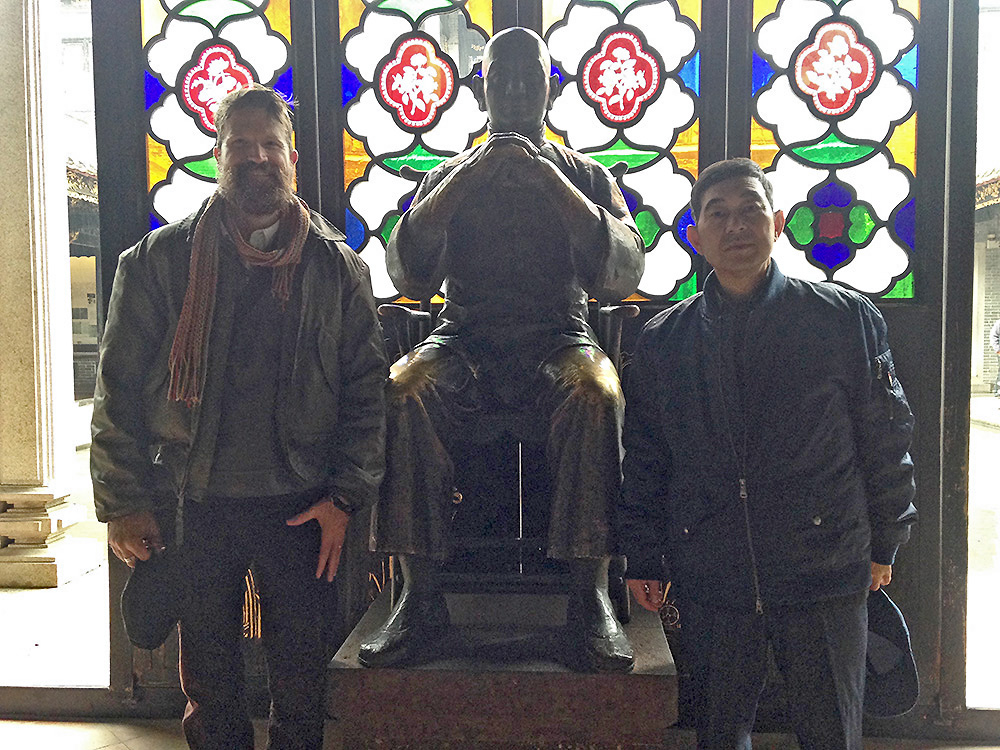
On a recent visit to China, my sigung, Grandmaster Yee Chi Wai, would tell me, “You don’t fight in a competition to win—you fight for the experience.” There’s more than one layer to that. But it’s where I’d gone wrong in that fight, and why, I can see now, I had won but still lost. Statham was fighting to win any way he could, and in playing his game I forgot rule number one, from point sparring to the street: Guard your ever-loving face.
Luckily, one of my teammates managed to take a photo of my face just as that ref raised my arm and the blood came gushing out. Every so often, when I see that image and remember that feeling, I think, Would a medal have taught me as much?


