
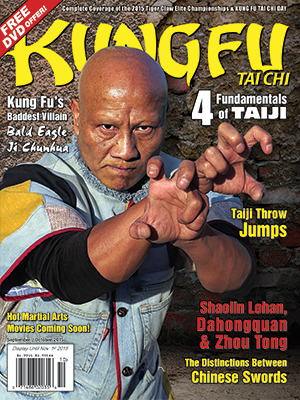
 Grandmaster Ji Chunhua passed away on July 11, 2018, at 10:37 AM. He is most remembered as "the Bald Eagle," starring in over 50 films beginning with the pivotal groundbreaking blockbuster THE SHAOLIN TEMPLE (1982). He was the Kung Fu Tai Chi Cover Master for our September+October 2015 issue – a cover story titled "The Bald Eagle" by Gene Ching and Gigi Oh. We also published "Ji Chunhua, the Bald Eagle, on Fate, Role Models, and the New Wuhang" by Gene Ching and Gigi Oh, a parallel web exclusive article for that cover story.
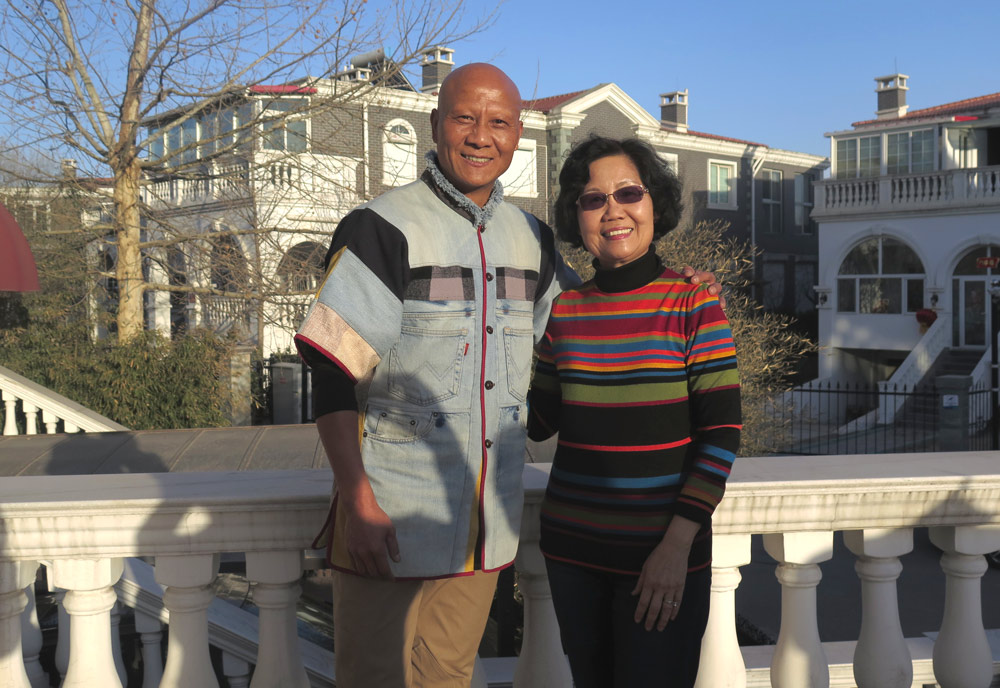
“I was really sad and shocked to hear of his death,” says Gigi Oh, Publisher Emeritus for Kung Fu Tai Chi the day after Ji passed away. “I was really looking forward to meeting him again when I go back to Beijing.” Gigi met Grandmaster Ji in March of 2015 when she and her son, Tiger Claw President Jonny Oh, made their annual business trip to China. Coach Wu Bin met them at the airport and said he had arranged a meeting with someone very special. “We went to Ji Chunhua’s house in Beijing. It was a nice two-story villa. He treated us to a wonderful home-cooked meal. Master Xu Xiangdong was there too. The first thing Ji said was that Coach Wu told him he was going to bring some American magazine big shot over, and he was surprised to find out that I was female and didn’t do martial arts, except for some qigong. Many people in the martial arts call me only by the title Wulin Mengzhu (literally ‘martial forest oath master,’ an honorific title for leaders of the martial arts world 武林盟主). I don’t like to mention that because it’s too big of a title for me.
“Ji was very warm, open minded and straightforward. We talked about his career, about being cast as the villain, and his disease.” Ji suffered from Alopecia universalis, a disease that robs the patient of all their body hair. Ji also spoke to Gigi about how that made him depressed because he could never be a Wushu champion because of his baldness. Although it was never an official rule, physical appearance of a competitor factored into their success back then.
But fate shined on Ji when he was cast in THE SHAOLIN TEMPLE, the same film that launched Jet Li’s career. With his intense eyebrow-less stare and bald head, Ji was typecast to play villains for the majority of his career. He was very down-to-earth about it, always giving credit to his directors. He said he was just a martial artist, following the director’s lead. It was a difficult path for him. As the villain, he got beat up a lot, and even though it was faked for movies, he took a lot of serious injuries over the years. He was nearly disabled on several films. He suffered traumatic neck and leg injuries, so many bad injuries. But he always pulled himself back up and used extreme methods to regain his normal state of health. He was very mindful of his health and his body. He always ate healthy and trained daily. “People pay me to do martial arts,” Ji told Gigi, “so I have to always be at my best.” According to Gigi, “If he wasn’t hurt that much, he probably wouldn’t go see a doctor.” He finally went in for some back pain three months prior to his passing, only to discover he was in the late stages of lung cancer.
“We did the cover shoot on the patio of his home,” remembers Gigi. “I’m not a professional photographer. Just like working with Grandmaster Yu Chenghui (another star who debuted in THE SHAOLIN TEMPLE), Ji directed me on how to take the cover photo. The sun was very harsh on that balcony. Ji gave me a lot of advice. He was always trying to help people. He was always very positive and humorous. I really liked his outlook on life.”
Towards the end of his career, Ji was cast in a few roles where he played the good guy and he was very proud of that. In the Chinese movie Shinming Jian Ou he played a good policeman, and in the Chinese TV series Dragon Locomotive he was also a good guy. Both projects were charitable promotions in his mind, aspiring to show good role models for Chinese audiences. “Society needs good role models,” said Ji.
“He felt there were no big or small people,” remembers Gigi, “as long as you do the best for yourself. He wasn’t a big dreamer. He just worked diligently through his whole life. I really related to him and really respected him. He was very generous and open in the interview. He would just pull his heart out to help you. In that way, he touched my heart the most of all the masters I’ve worked with.”


