
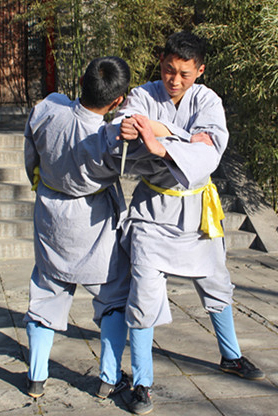
 Chin Na (aka Qinna 擒拿) is one of the four categories of any Chinese Kung Fu system. The word na (拿) in Chinese means to seize or hold. In Songshan Shaolin, the birthplace of martial arts as we know it, it can be unexpectedly difficult to learn these skills at present. Most of the schools in and around Shaolin these days teach a combination of kong fan (acrobatics空翻 []), jibengong (basics 基本功) taolu (forms套路), Sanda (kick boxing with throws散打), and some jueji (specialty skills 绝技). Many of the old ways and applications are being lost with time. It is not uncommon for current-day students to train in the empty hand and weapons forms without learning the meaning behind the movements. After moving to Songshan Shaolin from Shenzhen in southern China, I was lucky enough to meet a teacher by the name of Shi Yan San who started training at the Shaolin Temple 40 years ago, when Chin Na was still a part of the student's daily training.
I met this teacher through another of my Shifus and struck up a friendship with him. The close proximity of our homes made it easy to begin training privately under Master Shi Yan San.
These private lessons take place outside the teacher’s home with a view of the mountains behind us. Small mats are placed over the concrete driveway in front of the home, and knowing how to take a proper fall is a must. A roiling routine similar to that taught in the Beijing-style Shuai Jiao (jacket wrestling 摔跤) schools is a familiar part of Shaolin Chin Na practice. However, because I had previously trained in the art of break falls after examination there, Master Shi Yan San did not feel the need to reteach me such skills.
Master Shi Yan San has a laidback manner of teaching. Usually I arrange a time with him over the phone and show up at his home, about a 15-minute walk from where I live. Master Shi Yan San does not run a school but takes on students as they become available. When not teaching, he often travels to other cities to help out Kung Fu brothers with teaching and other responsibilities at their schools.
By the time I get to Master Shi Yan San’s home, he is usually engaged in some kind of housework or chores, so I warm up on my own. Ten or fifteen minutes later he will stroll out and begin working on some techniques with me. Because I find it hard to remember so many different skills that I learn while living in the Songshan Mountains of Shaolin, I usually tape the lesson to review and catalog the training, which I plan to teach in the future. The material Master Shi Yan San goes over with me in class is often him simply using me as the throwing dummy along with explanations of how and why the techniques are applied. It is up to me to grab a student whenever possible and practice these techniques on my own time.
On a recent visit, Master Shi Yan San presented a rubber knife and informed me that the day’s lessons would consist of how to defend against a knife using Chin Na techniques. The Master began with a speech about the importance of footwork and avoiding the initial attack. Second came the importance of capturing the limb. A memorable story of my older brother comes to mind here. He was a skilled wrestler who once helped out a friend being assaulted in a bar by a man armed with a broken bottle. My older brother used the same principles described by the Master here to successfully fend off the attack.
He then handed me the mock blade and told me to attack. “What type of attack should I do?” I asked. “Any,” he told me. So I proceeded to attack with a diagonal swinging slash designed to cut open an opponent’s belly if it were a real blade. Within seconds of the attack I found myself tied up and on the floor, my attacking limb locked and the teacher kneeling on me with one knee. It is interesting to note that this finishing position is common in today’s BJJ and MMA competitions and is known as the knee on belly position. With Shaolin being the predecessor to all modern martial art grappling systems, it is not surprising.
That day we went on to cover five different attacks and their defenses during class. All down on the hard concrete with only a small puzzle mat to help cushion the falls. As with all Shaolin fighting techniques, the applications are not set in stone. Instead, they are flexible and creative, and students are encouraged to explore, adapt, as well as to create new versions of the movements.
The way things are taught here in Shaolin, I would not be surprised if this lesson never comes up again. That day, the five techniques taught to defend against a knife were the straight stab, overhand plunge, inside-to-outside slash, outside-to-inside slash, and upward-arcing belly stab. With a little creative adaptation, the variations become innumerable. Thus is the nature of Shaolin training; a lesson has more than one meaning.


