

Master Bryant Fong and his Ancestral Altar.
On a pleasant Monday evening in April, on Earth Day 2019 no less, I had the unique honor of serving as a witness for a discipleship ceremony. Master Bryant Fong, our September+October 2014 cover master, accepted a group of new disciples in a traditional ceremony at the Hong Kong East Ocean Seafood Restaurant in Emeryville. We covered the ceremony in a short report in our FALL 2019 issue: "Sifu Bryant Fong Accepts Disciples." While bearing witness to this familial ritual, I reflected upon discipleship and my longstanding friendship with Master Fong. It was more than what fit into that report, so I'm publishing this on KungFuMagazine.com here.
Master Fong studied under the late Grandmaster Wong Jack Man, which makes us relatives within the Bak Sil Lum clan. There, Bryant is more akin to my martial uncle than my big brother. However, "Big Brother" makes for more eye-grabbing title, and I know Bryant understands the need to grab eyeballs on the web so hopefully he’ll forgive it. We’ve been through a lot together over the years and I’m sure he knows how much I respect his experience. “You’re part of my story,” he told me when he asked me to be a witness. He is part of mine too. Having overseen U.C. Berkeley’s venerated Chinese Martial Arts Tournaments (CMAT as we call them) for nearly three decades, he truly is my big brother when it comes to tournament promotions, and I often seek his wisdom.
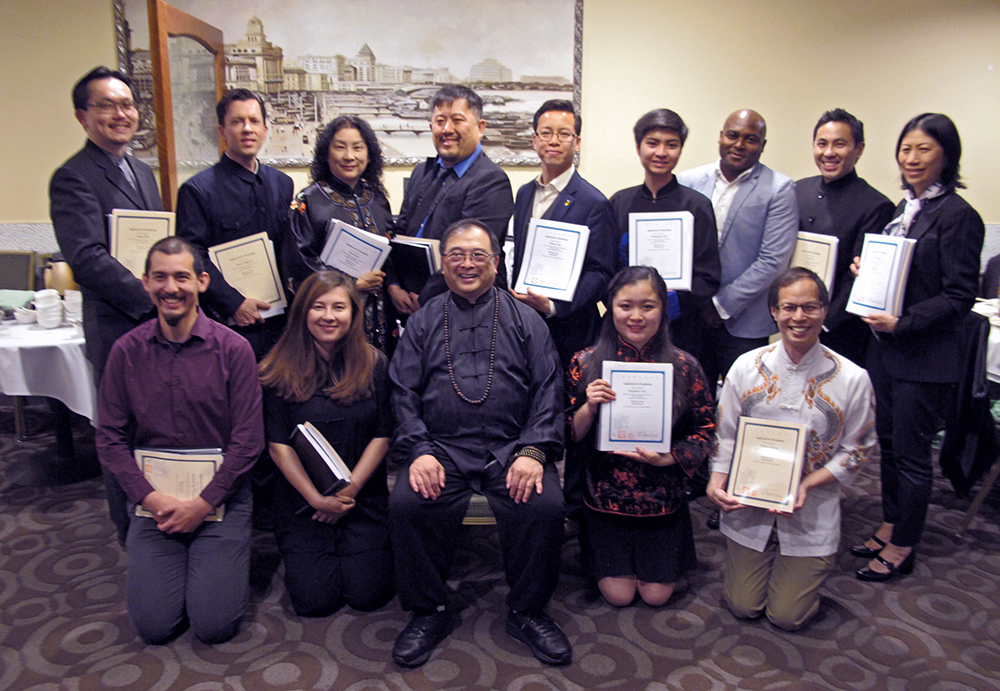
Master Bryant Fong and his newly accepted disciples.
Me and My Uncle
I'm not exactly sure when our story began, when Bryant and I first met. Most likely it was the late '80s or early '90s. I competed in some CMATs back then and I remember him MCing, but I doubt that we were formally introduced there. I was just another competitor. Today, I can't remember how many CMATs I actually entered or if I ever even placed. I have a few medals that don’t have ascriptions. Maybe one of those was from a CMAT win? I’d like to think so.
I began writing during the early '90s and was working for my first Kung Fu teacher, Grandmaster Kwong Wing Lam, as his head Bak Sil Lum instructor, as well as helping to launch his martial mail order company. Perhaps that’s when Bryant might have first noticed me. Lam made custom Kung Fu weapons and Fong acquired a few. We might have met more formally at Lam Kwoon. Eventually, I sold gear for Lam at a CMAT table and Bryant, being a good promoter, got to know his vendors, so we definitely got to know each other by then.
However, it was at Shaolin Temple where we really connected. In 1996, just prior to the 4th of July, we crossed paths there. I had been in China for a few weeks, coming from a research trip to Beijing to spend a month training at Shaolin Temple. Bryant was leading a tour of martial artists across China and naturally Shaolin was one of their stops. As fate would have it, we had lunch in the Wushuguan cafeteria at the same time. It gave us both Shaolin cred with our squads. The people I was training with were impressed that I knew this noted master leading a China tour. Bryant’s tour group seemed impressed that he knew someone there too. "Not many people were going to Shaolin back then," remembers Bryant. Whenever you bump into a friend on the road, it's very bonding.

L-R: Xinglong, Shi Decheng, Xingda in Shi Yanpu’s private chamber within Shaolin Temple.
That was also the year that I went through my own discipleship ceremony. I discipled under Shaolin Monk Shi Decheng, who I had trained under the year previously. In fact, one of the major reasons I returned to Shaolin was my personal mission to become his disciple. Back then, very few Americans had taken disciple vows under a Shaolin monk. Nowadays, I see some Shaolin masters offering discipleship on the web. When I first became a Shaolin disciple, there were only a few dozen of us American disciples. Now there are thousands, more than sand on the seashore, more than numbers. But I was one of the early ones, as denoted by my Shaolin name.
I got Master Lam's blessing to disciple under Decheng prior to returning to Shaolin. Even though I owe Lam my Shaolin foundation having been his student since the late '70s, he understood. Lam wasn't that into taking disciples at that time and only had a few. Years later, he accepted a group and he offered the opportunity to me too, but I declined. While some practitioners will take disciple vows under several masters, that just wasn't my way.
For me, discipleship is parallel to marriage – you take vows to commit to another person, except instead of wife and husband, it’s master and pupil, or parent and child. Chinese weddings are parallel to disciple ceremonies, particularly with the bowing and ritual tea offering. While some might be polyamorous or serial monogamists, that’s just not my style. Such vows are lifelong commitments. When someone asks me about becoming someone’s disciple, I remind them that "there’s no divorce in discipleship." With a chuckle, Bryant added, "In the old days, the master just kills them." Lam understood about my choice not to become his disciple. I’m very lucky and grateful that he had such an open mind about such matters.
Disciples of Shaolin Temple

In general, discipleship ceremonies are similar but sometimes with special rituals unique to the specific lineage. There is always an ancestral altar with photos of the master’s master (or masters). Photos of other significant masters in the lineage, as well as some image symbolizing the founder, might also be included in that altar. After all, to become a disciple is to join this family. There is a sequence of bowing to the ancestors and bowing to the master by the disciple candidates, and then there is a ritual where the disciple offers the master tea. The disciple will recite vows. These are specific to the lineage, sometimes passed down for generations, sometimes created or modified by the master accepting disciples. The applicant gives the master hongbao, lucky money in a red envelope. The master might give the disciple some token of acceptance, a book, an object, something usually relevant to the lineage. Some disciples adopt a lineage name. For example, the students of Master Yu Jim-yuen all adopted his "Yuen" as in Yuen Biao, Corey Yuen, Yuen Wah, Yuen Qiu and more. Master Yu’s two most famous pupils, Jackie Chan and Sammo Hung also had Yuen names, Yuen Lo and Yuen Lung respectively, but they dropped them later in their career.
There’s an important distinction between indoor and outdoor disciples. An indoor disciple is a lineage holder. An outdoor disciple usually has permission to teach, but isn’t always privy to all the teachings and is not considered an inheritor of the system. The distinctions between indoor and outdoor are somewhat ambiguous, depending upon the tradition within that specific clan.
Shaolin discipleship ceremonies are a little different than general Kung Fu ceremonies. Shaolin vows are, first and foremost, layman Buddhist vows. After all, Shaolin is a monastic tradition. In Buddhism, layman vows are called "taking refuge" and it’s a stepping stone to taking full monastic vows. There’s still the bowing and hongbao, but not necessarily the tea ritual. There is usually chanting of Buddhist sutra. Shaolin disciples take a Shaolin lineage name too. These names are based on an epic poem. Each name comes from one of the 70 characters in that poem. We published it along with the translation and pinyin in our Shaolin Special Issue (2000), which is now out of print. Decheng is 31st generation, so his name adopts the 31st character "de." Because I’m his disciple, I’m part of the 32nd generation using the 32nd character "xing." The Abbot, Shi Yongxin, is the 33rd generation so he uses "yong." After he took abbacy, many re-discipled under him so the most prevalent generation now is the 34th and they are all "yan." Each line of the poem has five characters, and the final character of 7th line is "heng," and there are several disciples bearing that name now. The next line is as follows – 36: "miao," 37: "ti," 38: "chang," 39: "jian," and 40: "gu." The youngest I think I’ve heard of at this writing is "chang," but given the rate of Shaolin expansion, there are surely younger now, or will be very soon.

Dieter’s Shaolin Temple tattoo
with Shi Decheng’s name.
My discipleship ceremony was held inside Shaolin Temple, in the private quarters of Shi Yanpu, who solemnized the ceremony. I was joined by my dear Shaolin brother, Dieter Wagner, and our witness was none other that our guide, Matthew Polly, who went on to become a noted martial arts author. "Disciple order is significant," commented Bryant at his ceremony. It's a nod to Confucian hierarchy. The eldest is the most venerated. He was very meticulous that his new disciples took their vows in a specific order. When I went through my discipleship ceremony with Dieter, I went first and Dieter followed, so I’m Dieter’s big brother. We accepted our Shaolin names – mine is Xinglong, Dieter's is Xingda. Decheng commemorated the ceremony by presenting us with engraved swords. Unlike the legends, we did not have to get brands, but Dieter did get a tattoo on his own.
At first, my discipleship under Decheng was largely symbolic, but over the years it grew in depth to become more meaningful. I returned to Shaolin several times and only missed him once because he was travelling. He travels a lot. And he's come to the Bay Area many times now too. Again, I feel very lucky and grateful that it all worked out.

The sword gifted to Gene Ching by Shi Decheng, engraved with their names and the date.
Can I Get a Witness?

Martial Marital before the Lam Kwoon Altar: L-R: Witness Raymond Wong, Bride Lori White, Solemnizer Gene Ching, Groom Gary Shockley .
Everyone who attends a discipleship ceremony is a witness, however some invitees are specifically designated witnesses. These witnesses are usually representatives from the master's lineage or notable VIPs from other lineages. For Bryant's ceremony, Gigi Oh, our Publisher Emeritus, was also invited to be a witness along with two masters who have contributed to Kung Fu Tai Chi in the past, Master Liang Keming and Dr. Johnny Jang (also a master as well as another personal martial uncle of mine). Beyond the master, the disciples, the witnesses and the attendees, there is the solemnizer who directs the ritual. This is usually another significant person in the lineage, a previous disciple, or some VIP significant to the master. In my case at Shaolin Temple, it was a senior Shaolin monk, Shi Yanpu. Having been a disciple and now a witness, I also served as a solemnizer for a ritual at Lam Kwoon once, but it wasn't quite a discipleship ceremony. It was a wedding. Like I said, they are parallel.
On an auspicious date with lots of 9s, September 9, 1999, I served as a solemnizer for the copy editors of Kung Fu Tai Chi, Gary Shockley and Lori White. They wanted to do a Kung Fu wedding, fusing the martial and the marital. It's not really something that exists. Or maybe it does. It does now. We couldn't find a specific ritual so we incorporated elements from Chinese wedding and discipleship ceremonies. It was a lot of fun, so lovingly charming. Being writers, they wrote their own vows, adding humorous nods to Kung Fu. Bows were made and tea was served. I donned Shaolin Robes and was ordained as a wedding solemnizer through the Universal Life Church. It was an honor to serve as solemnizer to my dear Kung Fu siblings. We've trained together, competed together, travelled China together, shared so many experiences, now we work on the magazine together, but that one was truly special. And since then, I've solemnized four weddings in all, although the other three weren't martial. Two of those four are still married, including Gary and Lori.

Tea Ceremony.
But back to Bryant's disciple ceremony, I was the only witness who was a martial disciple. Not all masters are disciples. For many, there's no need for that. Master Liang is the son of Grandmaster Liang Qiangya (1931–2013), an outstanding proponent of Fu Style Baguazhang and Taijiquan. Being in the bloodline meant there was no point in taking disciple vows. His master already was his father. Dr. Johnny never discipled under anyone either. He has always been a voracious student of the martial arts and has studied under several masters, many of whom certified him to teach. However, he never took any vows. Gigi hasn't discipled under anyone either. Although she is an avid qigong practitioner and a significant figure in the world of Chinese martial arts, becoming a martial disciple isn't a commitment she plans to make. She was very delighted when the disciples, as part of the ritual, kowtowed to us witnesses. "I've never had anyone bow to me like that," she gushed. Bowing is such an integral part of the martial arts. The rest of us were quite amused by her admonition.
Bryant is himself a disciple of Grandmaster Zhao Da Yuan, the second to take vows of 21 disciples and the only overseas representative. After Grandmaster Wong Jackman passed, Bryant felt the need to get stronger commitments from some of his students to continue the lineage, inspiring this large disciple acceptance ceremony. He sealed them with their disciple vows. Discipleship is all about legacy. It's about swearing to hold up a specific tradition and pass it down faithfully. It's by no means a requirement for martial mastery. It's about honor. I hope that anyone who decides to take discipleship vows honors their vows.

L-R: Gigi Oh, Bryant Fong, Dr. Johnny Jang, Liang Keming, Gene Ching.
Master Bryant Fong's Disciples in 2019
2011 disciples: Ben Tang, Jason Fong, Mike Jong, and Bruce Wong.
2019 disciples: Indoor: Dr. Sunny Pak, Dr. Cary Lee, Coach Darren Hsiung, Steve Colegrove, Rhonda Jew, Kai Chang, Cecilia Springer, Mason Tong, Jacqueline Lam, Christopher Lam. Ernest Sanders, and Elsa Cheung. Outdoor: Antonio Yip Wlassowsky
About author:
Subscribe to KungFuMagazine.com here.
Get your print edition of the MID-AUTUMN 2026 here.
Gene Ching is the Publisher of KungFuMagazine.com and the author of Shaolin Trips.


