
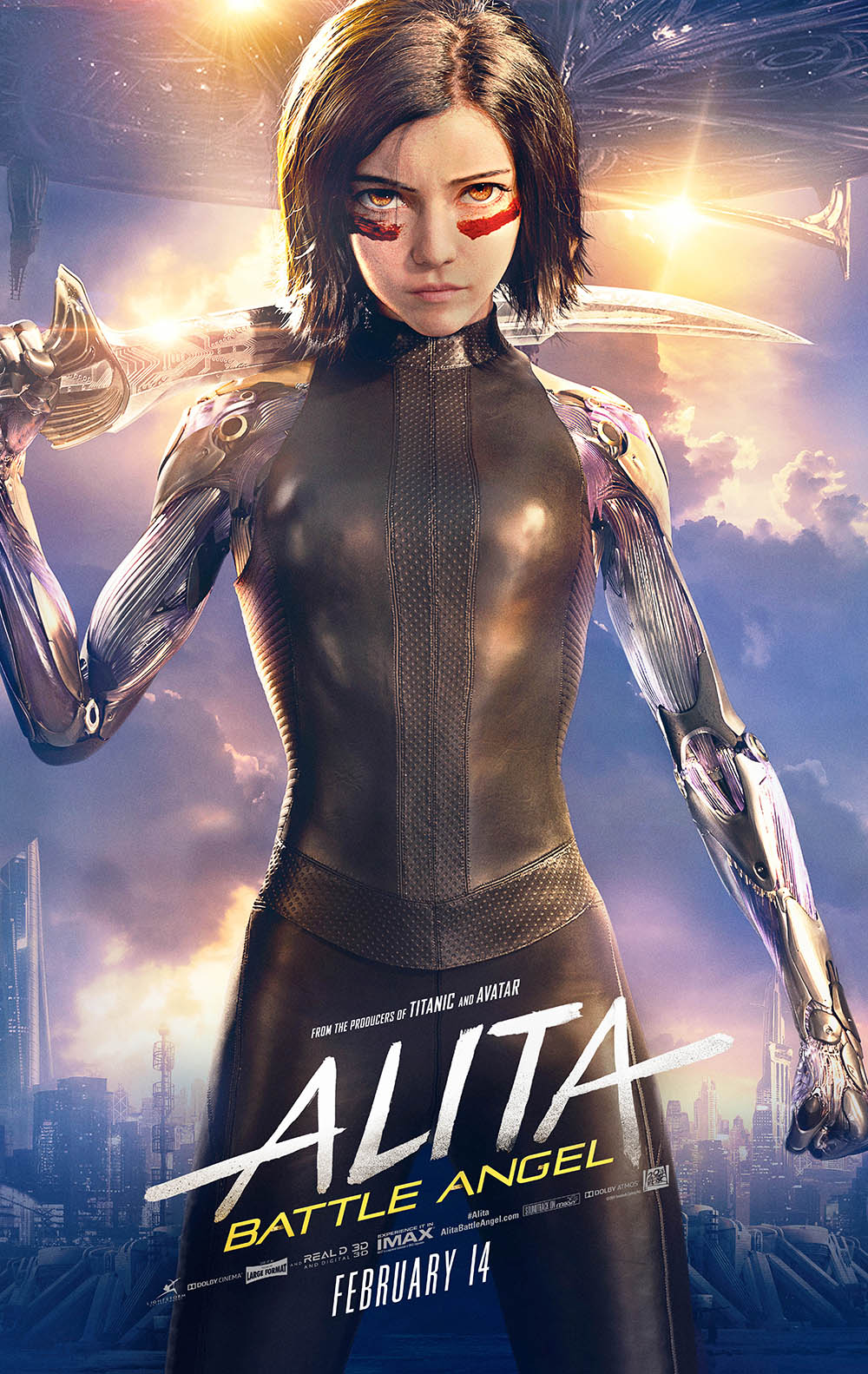
 Remember when MMA first came out and everyone was saying ‘All fights go to the ground’? Would that still happen in zero gravity? This is something that Panzer Kunst ponders – how would the martial arts be in space? And what if the enemies were cyborgs? And what if those cyborgs had swords?
Panzer Kunst is German for “Armored Art” and it’s the product of the visionary world of Alita. ALITA: BATTLE ANGEL is a new feature film from Director Robert Rodriguez based upon the 9-volume cyberpunk manga series Gunnm originally published in 1990 by Yukito Kishiro. That manga is still going; Kishiro revisited Alita's world in several successive series. The most recent reboot began in 2014, Battle Angel Alita: Mars Chronicle, and it is still in print today. With such a large and long-standing canon of comics, Kishiro’s inventive zero-grav cyborg martial art of Panzer Kunst is very well fleshed out. Practitioners are called ‘Kunstlers’ (German for artists) and the combat art is described as tactics that give smaller opponents the advantage against larger opponents. Arguably all martial arts aspire to this philosophy. Nevertheless, Panzer Kunst makes for a good manga construct that justifies how Alita, a teenage-girl-sized cyborg, can easily defeat opponents many times her size.
It is the action that really shines in ALITA: BATTLE ANGEL. Alita is a master of Panzer Kunst and deploys it to fights off a horde of blade-wielding cyborg foes throughout the film. Rodriguez has always had a great eye for fight scenes. From his family-friendly SPY KIDS franchise (2001, 2002, 2003) to his gratuitous ultraviolent MACHETE franchise (2010, 2013), Rodriguez has delivered top-notch fight choreography, making the most absurd action sequences totally acceptable within the context of the story. Panzer Kunst gave him full license to explore a whole new realm of fight physics.
The fight scenes are only upstaged by Alita herself, portrayed by Rosa Salazar with CGI-enhanced anime eyes. It's the best CGI mask since Gollum in THE HOBBIT franchise and the Na'vi in AVATAR (2009). Salazar did all of her scenes as performance capture, which not only mapped her body movements but also her expressions. Those huge anime peepers are ever present and inescapable, but they work. Despite her cartoonish appearance, Alita feels authentic, at least as authentic as a teenage warrior cyborg can be. Alita is charmingly and disarmingly doe-eyed, but unleashes a brutal can of girl-power whoop-ass when she unleashes her Panzer Kunst.
In preparation for the role, Salazar says she trained in Muay Thai, Eagle Claw and Kickboxing and those styles are readily apparent in the Mirror Punch scene. Cinematically, these are now the fundamental elements of Panzer Kunst. While veteran stunt person and former Karate and Taekwondo champ Mickey Facchinello served as Salazar's stunt double for all the heavy-lifting when it came to the fighting action, it was important to the filmmakers and Salazar that she be trained as well. As James Cameron put it, the martial arts "informs your posture" and that was critical to make the performance capture convincing.

James Cameron has held the rights for Alita for years. It has been a dream project of his, but he got so immersed in his Avatar franchise that he passed it along to Rodriguez to see it through. Cameron still wrote the screenplay making ALITA: BATTLE ANGEL into a fascinating collaboration from two very different filmmakers. Cameron, who always goes big, turned this into a $200 million production. Rodriguez, who burst onto the film scene with EL MARIACHI (1992) made with a mere $7000 budget, now hosts REBEL WITHOUT A CREW, a reality show where filmmakers are given $7K to make a feature length film, on the EL REY NETWORK, which he founded. The filmmakers are long time friends, and Rodriguez describes their filmmaking differences in terms of their roots. His roots are in cartooning, so his cinematic visions are more fanciful. He says Cameron began as an illustrator so he focuses on how things work. By comparison, Rodriguez cites how in EL MARIACHI, the machine-gun guitar was accepted without question, but had Cameron taken that on, the way it actually worked would have been a factor. Their filmmaking styles meshed in ALITA: BATTLE ANGEL. Despite the special-effects heavy story, they choose not to just shoot the whole world in green screen. Instead, they built a massive detailed set for Iron City, giving the actors a genuine environment to work within.
Some of the story details are a tad banal. The centerpiece sport Motorball is derivative of ROLLERBALL (1975). The floating city of Zalem capitalizing and oppressing a lower-class earthbound ghetto of Iron City echoes ELYSIUM (2013) although that film came much later than the original Alita manga. However the same concept was explored in the original STAR TREK episode titled “The Cloud Minders” (1969). ALITA: BATTLE ANGEL focuses mostly upon her origin story, world building, and furious Panzer Kunst cyborg fights. Even in the cyberpunk genre, originality can be hard to find.

Robert Rodriguez is mi jefe (my Boss)
On a personal note, I ride with El REY. I'm one of the weapons experts on EL REY's original series, MAN AT ARMS: ART OF WAR, so I've met Robert - we were even on an episode together in Season 1 - but I was unable to reach him in time for this review. I did chat with my cast mate Marko Zaror, who has a cameo in ALITA: BATTLE ANGEL. Zaror plays Ajakutty, a Hunter-Warrior like Alita who becomes significant later in the manga saga.
Unfortunately most of his scenes didn't make the final cut. “I did a fight with Alita at the bar,” says Zaror. “I had a face off with her. I did some tricks. Also they are fixing me in the Pits, etc." But with any production, tons of footage gets left on the cutting room floor. Nevertheless, a veteran stunt person like Zaror knows that's just how the business goes. He says it “was the best experience ever! I feel so fortunate to be part of that, was lots of fun.” And who knows? ALITA: BATTLE ANGEL is positioned to be another fantasy film franchise and Ajakutty allies with Alita later in the manga. What's more, it could inspire more people to take up the martial arts.

Movie Martial Arts - A New Trend in Practice
The notion of fictional martial art becoming reality might seem absurd to non-practitioners, but anyone who’s studied Kung Fu at length knows better. Myth and legends figure heavily into martial arts. China’s beloved Monkey King has given rise to countless Monkey King Staff forms, and other great legends are echoed in practices like the Kwan Dao of General Kwan or Wu Song Breaks Manacles which reenacts an escape scene from the classic saga of Outlaws of the Marsh. Movies create modern myth, so even though the idea of martial arts inspired by movie fiction seems nerdy on the surface, there's plenty of traditional precedent.
Today, the martial arts have already been heavily inspired from movies and TV. STAR TREK: THE NEXT GENERATION introduced Klingon Martial Arts and their fanciful weapon, the Bat’leth. Films like Robert Downey Jr’s reboot of Sherlock Holmes (2011) and SUFFRAGETTE (2015) spawned a revitalization of the European fighting art Bartitsu. And the biggest force when it comes to ‘new’ martial arts came from STAR WARS. Jedi Academies have sprung up all around the globe, propounding the proper use of Lightsabers. Many martial arts schools offer programs based on Star Wars, Teenage Mutant Ninja Turtles and Kung Fu Panda as teasers to get people hooked into the practice.
Will Panzer Kunst be the origin of another new martial art? If the United States really launches a Space Force program, zero gravity combat will be something to consider. But for now, ALITA: BATTLE ANGEL is poised for a sequel. As Dua Lipa sings in her end credit ballad Swan Song “This is not a Swan Song…It’s a new life.”

About author:
Subscribe to KungFuMagazine.com here.
Get your print edition of the MID-AUTUMN 2026 here.
Gene Ching is the Publisher of KungFuMagazine.com and the author of Shaolin Trips.


