
 In traditional Asian martial arts, forms (kyun 拳) are the medium through which the particulars of a system’s martial methodology are conveyed. Techniques (kyun faat 拳法), their body methods (san faat 身法), and one’s martial intent (yi 意) are all communicated by way of these prearranged routines. A form can either complement or supplement the other sets within a style. When a kyun is considered complementary, it serves to complete a particular set of signature combative concepts which typically define an art. When a form supplements the core routines of a system, it customarily has been imported and personalized to incorporate martial attributes not found within the system. (This is commonly seen with weapon sets.)
In Pak Mei Kung Fu, sap baat mo kiu (18 Stripping Bridges 十八摩橋) is a complementary set that characterizes transformation within the system’s canon of four fundamental kyun, the three others being jik bou (Straight Stepping 直步), gau bou teui (Nine Step Push 九步推), and maang fu cheut lam (Fierce Tiger Leaves the Forest 猛虎出林). It serves as the bridge between practice and practicality, understanding and internalizing, and immutability and adaptability. In order to grasp the set’s significance, its source, specifications, and design need to be examined.
Origins: Dead Strength vs. Dynamic Force
Pak Mei Kung Fu (白眉武術), literally White Eyebrow martial art, is named after the folkloric founder, who was reimaged as the notorious Pai Mei in Shaw Bothers and Kill Bill: Volume 2 films. It derives from the self-defense methods indigenous to the reclusive Hakka (客家) natives of the eastern tributary of the Pearl River (珠江) known as Dongjiang (Dunggong in Cantonese 東江) in Guangdong Province, China. The art was the realization of Master Cheung Lai Chuen (宗師張禮泉), whose martial beginnings as a young child during the latter part of the 19th century led to his acquisition of an unknown and nameless style in his young adulthood. This guarded collection of combative concepts, which he briefly called Emei Shaolin (as pronounced in Mandarin 峨眉少林), was organized and supplemented with his previous martial studies, forming the comprehensive system now known as Pak Mei Kung Fu.
The martial material that comprised the core of Emei Shaolin methods was not merely an assemblage of effective techniques, but a manner of transforming raw strength (lik 力) to a refined force (ging 勁), which greatly enhanced the efficiency and effectiveness of techniques. This was a revolutionary breakthrough in the field of close-quarter pugilism. The general view that physical strength is the greatest indicator of martial prowess was challenged by the arcane Hakka perspective that muscular might has its limitations. Sheer size and inherent strength used to execute techniques was called sei lik (死力), literally dead strength, implying that a sole reliance on muscularity is inefficient because it yields functionally dull power that can be sensed and countered. To the contrary, ging is reliant upon ideal alignment, coordinated body movements with breath regulation, and intricate footwork to acquire a multidimensional dynamic force that is less apparent and harder to oppose.
To facilitate the attainment of ging, a formula of four sequences, each expressing a unique overarching precept – jik (straight 直), jit (joint 節), cham (sink 沉), and sing (rise 升) – systematically trains the body to achieve this martial force. Of these four routines, sap baat mo kiu is the avatar of cham.
Eighteen: The Mechanism, the Mode, and the Manifestations
Traditional Chinese martial nomenclature is often steeped in allegory, typically eliciting multiple interpretations that may all be applicable. 18 Stripping Bridges is a translation of sap baat mo kiu that follows this convention.
Numeric qualities play a large role in determining the auspiciousness of situations in Chinese culture. For example, the number eight (baat in Cantonese / ba in Mandarin 八) is associated with prosperity (faat / fa 發) as a result of its corresponding assonance. In the same manner, the number 18 (sap baat / shi ba 十八) sounds similar to sat faat (shi fa in Mandarin 實發), which means certain prosperity or guaranteed success. Martially, the number 18 is a theme that recurs in traditional Chinese martial arts such as the 18 classical weapons (sap baat bun bing hei / shi ba ban bing qi 十八般兵器) and the 18 Luohan (lo hon 十八羅漢). In Pak Mei, it represents the incarnation of technical and tactical power, meaning that there is a total of 18 characteristics that constitute the issuing force behind Pak Mei techniques. These 18 features are derived from three groupings that address the alignment, dynamics, and pugilistic properties of Pak Mei’s manifestation of martial force. Luk ging (六勁), literally the six forces, refers to the six sectors of the body that need to be synchronized for the production of ging. These areas are the legs (geuk 腳), waist (yiu 腰), shoulders (bok 膊), hands (sau 手), neck (geng 頸) and teeth (nga 牙). Various lineages may have different arrangements of the six body parts that may emphasize the importance of their respective areas. For example, the teeth may be swapped with the abdomen (fuk 腹) to emphasize the rising and sinking qualities of sei noi biu ging (四內標勁) – the four internal features of issuing forces – and the second grouping of power-producing attributes. Within this context, tan, tou, fau, and cham serve as descriptors detailing how martial force should be experienced and exerted by a Pak Mei practitioner. Tan (吞), literally meaning to swallow, represents the idea of devouring the energy of an enemy’s attack in a manner that neutralizes the threat and compromises his stability. Conversely, tou (吐), to spit, conveys a sense that the practitioner’s techniques must be discharged in an outward, lively, and decisive manner. Fau (浮), or float, suggests a state of relaxation akin to the sensation of remaining adrift on a body of water for the practitioner, and has an upward directional force found within techniques employing that respective vector. Cham (沉), to sink, is the complement of fau, which concentrates on the significance of the practitioner’s mass and aggregated strength when in contact with the opponent. As stated earlier, cham is also the focus of the form 18 mo kiu, which alludes to the idea that the training of this routine leads to more profound (another definition of cham) levels of skill and applications. When these ten factors have been secured, baat ging (八勁), the 8 principal manifestations of force, will support the execution of techniques. Bin (whip 鞭), got (cut 割), wan (pull 挽), jong (collide 撞), chung (charge 衝), taan (flick 彈), sok (yank 索), and pun (coil 盤) are the forces that will be used in complementary combative mannerisms within the framework of Pak Mei techniques.
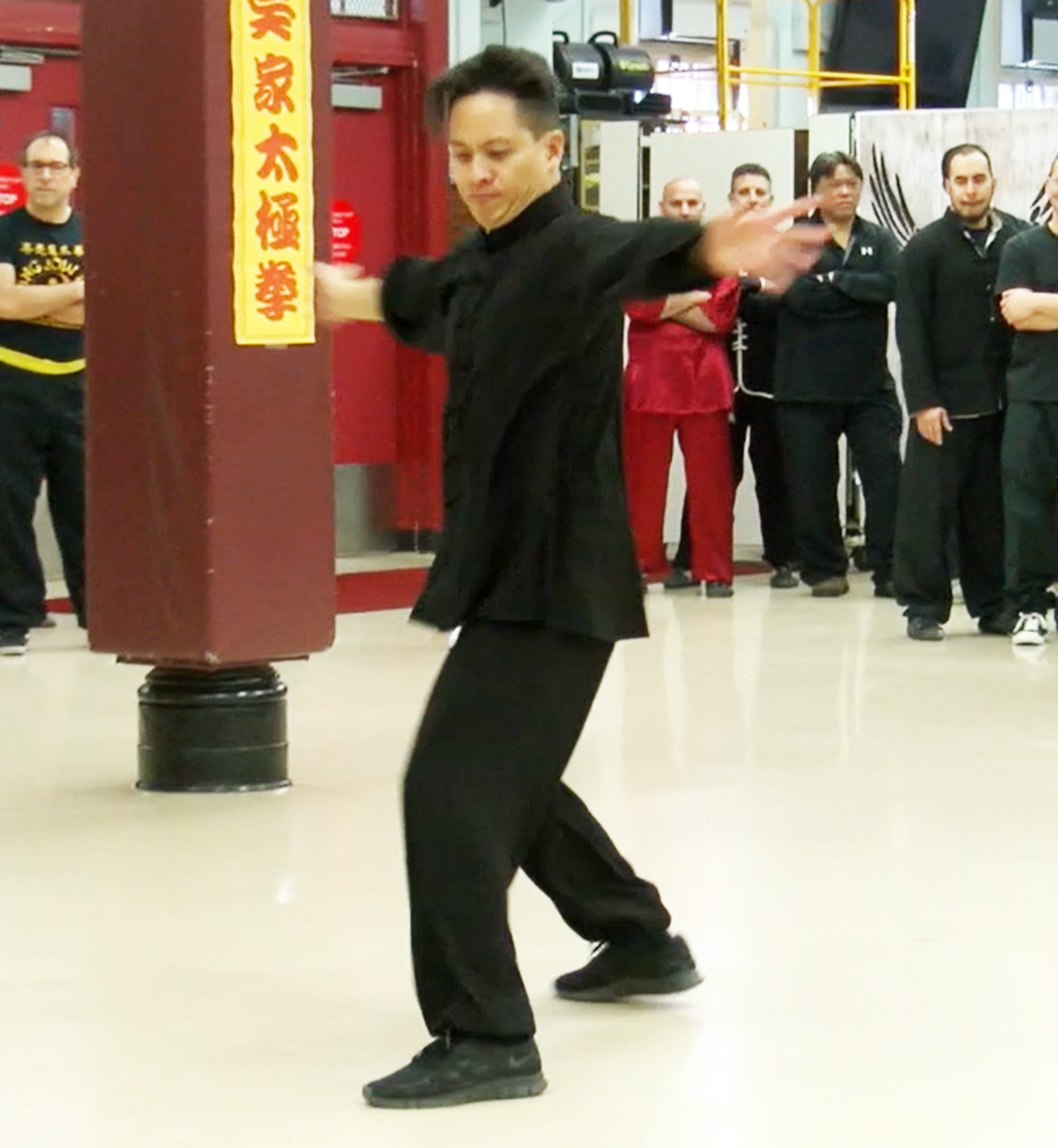
Mo Kiu: The Obvious and the Invisible
Mo kiu has often been interpreted as to rub or grind bridges, a metaphor for an opponent’s arms. The purpose of rubbing or grinding is to eventually strip away the superficial layer of the intended surface. However, it is not the physical action of grinding that is critical to the essence of 18 mo kiu, but the end result – the stripping away of the opponent’s ability to continue attacks – that is the key to the profundity of this routine.
To remove the adversary’s structures and malicious intent through both direct and indirect tactics is the primary combative goal of the training of sap baat mo kiu. While the system’s two previous routines, jik bou and gau bou teui, train the practitioner to be reactive and responsive to attacks, 18 Stripping Bridges reprograms the practitioner’s mindset to command and control the situation with a suppressing energetic signature, cham. The techniques from this routine are simply movements until they are martially armed by way of the eighteen facets of ging, which proposes the options of striking (da 打), kicking (ti / tek [Cantonese] 踢), throwing (shuai / seut 摔), and arresting (na 拿) – as in qinna (擒拿). The most apparent applications are striking and kicking since they are well-defined in the postures found throughout the form. They are fairly obvious. However, the less-visible methods are the possibilities embedded in the transitions – in the movements and moments that exist between postures. Here lie the lures, set-ups, and traps that serve to confound the opponent’s expectations and quell any premeditated attacks. In some circles of Pak Mei, these methods are known as gwai sau (鬼手), or ghost hands, due to an opponent’s inability to detect the techniques’ intentions. The allusion to ghost hands also corresponds to yin (of yin and yang 陰陽) methods that are associated with dark or obscure techniques – such as throwing and locking – not as openly emphasized in classical Pak Mei.
To assist the hand methods, a very aggressive set of footwork patterns accompany the upper body’s stripping agents: the pressuring step (bik bou 逼步), the hunting step (lip bou 獵步), and the leech step (kei naa bou 蜞乸步). The charging nature of these stepping patterns is devised to overrun the adversary from below while the arms manipulate and press from above. These wholly coordinated actions are calculated yet contingent movements that have the ability to adapt to the fluctuations that occur in altercations. In mid-step, a charging leg may become a knee attack, tripping mechanism, or pivot-point for the other leg to lead a spontaneous leg assault. While the pressure of the stepping is constant, the applications are organic, which amplifies the unpredictability of the practitioner’s techniques.
The stripping of an opponent's physical ability to cause harm must be balanced with a psychological suppression of the opponent’s desire to proceed any further with malice toward the practitioner. Typically, the inability for an opponent to physically continue also leads to an end to his combative persistence. Should he be determined enough to continue, varying methods of pressure are applied to extinguish his intent.
This suppression into total submission defines the multifaceted martial gradations of sap baat mo kiu, and the elaborate design of Pak Mei Kung Fu.


